
Bureau Européen de l'Objection de Conscience | Europäisches Büro für Kriegsdienstve
User login
EBCO report on conscientious objection to military service in Europe 2025 online
How militarised are you?
CoE interactive map
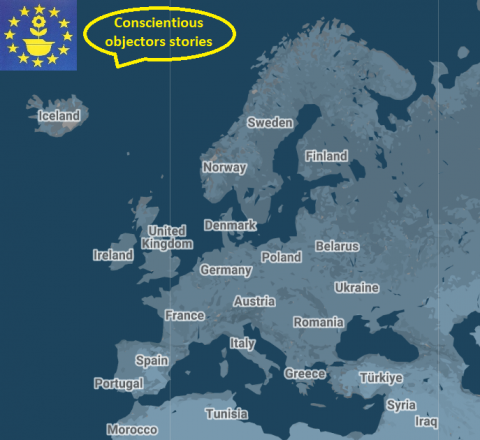
Conscientious objectors stories (videos)
#ObjectWarCampaign

EBCO Newsletter "The Right to Refuse to Kill"



Cyprus

Previous reports: 2024 | 2023/24
| Conscription currently imposed? | Yes | |||||||
| Conscientious objection first recognised | 1992 |
National Guard Act, 2/1992 (unarmed military service) Civilian alternative service finally became available in about 2005. |
||||||
| Current provisions | ||||||||
| Duration |
|
|||||||
| CO release of professional soldiers | Not permitted | Release from reserve service now possible. | ||||||
| Minimum recruitment age | 17 | “Voluntary” early performance of military service – way of calculating age means that enrolment may actually be at 16 | ||||||
| Military expenditure1 |
|
|||||||
Principal EBCO concerns
-
Alternative service is punitive and discriminatory, inter alia, in terms of its nature, cost, and duration.
-
Conscientious objectors are not recognised prima facie. The process has yet to be placed under the full control of civilian authorities.
“Turkish Republic of Northern Cyprus”
| Conscription currently imposed? | Yes | |||||
| Conscientious objection first recognised | No recognition | |||||
| Current provisions | ||||||
| Duration |
|
|||||
| CO release of professional soldiers | Not permitted | |||||
| Minimum recruitment age | 18 | |||||
Principal EBCO concerns
- No recognition of the right to conscientious objection despite repeated condemnations from international courts.
Developments
In 2025, EBCO and three other international organisations raised the case of conscientious objector Hasan Rahvancıoğlu and his prosecution by the authorities in the self-declared state of Turkish Republic of Northern Cyprus (TRNC).2
Rahvancıoğlu is facing three separate cases for refusal to comply with a mobilisation call. He has peacefully and publicly declared his conscientious objection to military service, stated that he will not pay any fines imposed by the court, meaning he faces imprisonment simply for exercising his freedom of thought, conscience, and belief.
His trial was initially scheduled for 27 November 2025 before the Security Forces Court, then rescheduled for 22 January 2026, then 12 March 2026, and still pending.
On the domestic level, the Constitutional Court and Military Court of Appeals in the “TRNC” have recognised the right to conscientious objection but in the absence of legislative reform, conscientious objectors continue to be criminalised.
The situation is a repeat of the previous treatments of Halil Karapaşaoğlu,3 Mustafa Hürben, and Murat Kanatlı, whose case led to a landmark ruling at the European Court of Human Rights (ECtHR), delivered in 2024 but still pending implementation.4 In March 2025, Türkiye in its communication to the Committee of Ministers of the Council of Europe about the case, noted the legislative amendment submitted to the “TRNC” Parliament in January 2024 by the opposition, but without mention to the stalling of the bill by the ruling majority who turned down a motion for urgency and has not advanced the bill since to enact it into law.5
- Military expenditure figures are estimates published by SIPRI (The Stockholm International Peace Research Institute) in April 2026.↩︎
- https://ebco-beoc.org/press-release/2025-11-24-joint-press-release-stop-prosecuting-hasan-rahvancioglu↩︎
- https://ebco-beoc.org/node/627↩︎
-
European Court of Human Rights, Murat Kanatlı v. Türkiye, Application no. 18382/15
Available at: HUDOC, https://hudoc.echr.coe.int/eng?i=001-231540↩︎
- https://search.coe.int/cm/eng?i=09125948802649cd↩︎