
Bureau Européen de l'Objection de Conscience | Europäisches Büro für Kriegsdienstve
User login
EBCO report on conscientious objection to military service in Europe 2025 online
How militarised are you?
CoE interactive map
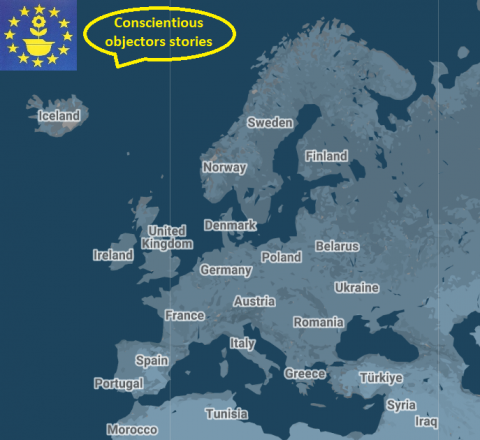
Conscientious objectors stories (videos)
#ObjectWarCampaign

EBCO Newsletter "The Right to Refuse to Kill"


Finland

Previous reports: 2023/24
| Conscription currently imposed? | Yes | |||||||
| Conscientious objection first recognised | 1931 | Alternative Service Act of 4th June | ||||||
| Current provisions | ||||||||
| Duration |
|
|||||||
| CO release of professional soldiers | No specific provisions | |||||||
| Minimum recruitment age | 18 | |||||||
| Population 1 |
|
|||||||
| Armed forces |
|
|||||||
| Military expenditure |
|
|||||||
Principal EBCO concerns
-
Alternative service is punitive and discriminatory in terms of longer duration (more than 2x that of military service).
-
Poor availability of information about the right to conscientious objection.
-
Reports that conscripts are deterred by military officers from applying to be transferred to alternative service.
-
Plans to introduce an obligatory national defence day for 17 year-olds. Military courses already offered to 16-17 year-olds.
As reported by EBCO's Finnish member, AKL (Aseistakieltäytyjäliitto - the Finnish Association of Conscientious Objectors):2
Developments
In February 2024, the Finnish defence minister Antti Häkkänen told the public about his intention to find a legal way to stop the reservist objection - launching a new flood of applications to the supplementary service. Currently it is unclear whether Häkkänen's idea will proceed to a concrete legislative proposal.
The current government coalition plans to introduce an obligatory national defence day for all 17 year olds in secondary education “to share information about national defence, conscription and comprehensive security”.
In addition to that, the Ministry of Employment and the Economy has informed that in 2025 they will set up a new working group to renew the Act of Non-Military Service in line with the government programme. According to the programme, the aim is to develop non-military service and link it more clearly to the comprehensive security model.
In AKL's view, linking the non-military service more closely to the comprehensive security approach, which includes military security, and preparedness in society, might endanger the conviction-based nature of the alternative service when focusing solely at crisis time instead of proactive peace building.
Conscription provisions and procedures
Conscription is based on the Constitution of Finland, Section 127, “National defence obligation: Every Finnish citizen is obligated to participate or assist in national defence, as provided by an Act. Provisions on the right to exemption, on grounds of conscience, from participation in military national defence are laid down by an Act.”
The Conscription Act, Section 2 defines the conscription further, “Military service: Every male Finnish citizen is liable for military service starting from the beginning of the year in which he turns 18 years old until the end of the year in which he turns 60, unless otherwise provided for herein.
Fulfillment of military service includes service as a conscript, participation in reservist training, extra service, and service during mobilisation, in addition to participation in call-ups and examinations assessing fitness for military service.
Persons liable for military service are in active military service, in the reserves or in the auxiliary reserves.
The legal rights of a person liable for military service may not, pursuant to this Act, be limited beyond what is necessary for his performing of military service, the maintenance of military order and measures that are necessary to ensure the safety of the persons liable for military service and other persons.”
The minimum age for conscription is 18 years.
According to the Conscription Act, Section 37:
The term of military service is:
-
180 days for training in the rank and file,
-
270 days for training for demanding duties that require special and professional skills,
-
362 days for officers, non-commissioned officers and conscripts trained for especially demanding duties
According to the Finnish Defence Forces, approximately 43% of conscripts serve for 347 days, some 14% for 255 days, and 43% for 165 days.
In 2024, in total 24 285 conscripts were ordered to the mandatory military service, meaning 76% of the male age group.3
For reserve service, according to the Conscription Act, “Membership in the reserve or auxiliary reserve: After persons liable for military service complete their military service, they become members of the reserve:
-
until the end of the year in which they turn 50 years of age, in the case of the rank and file,
-
until the end of the year in which they turn 60 years of age, in the case of officers, non-commissioned officers, and warrant officers,
-
as long as they are fit for service, in the case of an officer of the rank of Colonel, Captain (Navy) or higher.
Persons liable for military service belong to the auxiliary reserve if:
-
they have not completed military service,
-
no longer belong to the reserve, or
-
have been exempted from service in peacetime”
Section 50 defines the obligation to reservist training further, “Obligation to participate in reservist training: A person liable for military service who is in the reserves is liable for participation in reservist training. The maximum total time of the training is:
-
40 days for the rank and file,
-
75 days for persons trained for demanding duties that require special and professional skills,
-
100 days for non-commissioned officers, warrant officers and officers.
In addition to the times referred to in subsection 1, a person liable for military service may, at his consent, be assigned to participate in reservist training as a member of his or her wartime unit for a maximum of 20 days total per calendar year if that person is vital for the Defence Forces for the leadership or training of that unit. Moreover, such an assignment requires the written consent of the employer of the person in question if the training is to take place during working hours.
If a person liable for military service does not report for reservist training at the appointed time because of a legitimate impediment, he must do so immediately once the impediment is removed, unless otherwise instructed by the military authorities.”
Even if the law gives these maximum days for reservist training, not all reservists are called up for reservist service. There are a total of 870,000 reservists and approximately 280,000 are currently deployed in emergency situations. According to the Finnish Defence Forces, the majority of the latter group are participating in mandatory or voluntary reservist exercises during their reservist time.4 Year 2024 about 25,330 reservists were called up to training.5
The regional office of the Finnish Defence Forces orders the reservists to the training through letters they send at least three months before service. An exception to this three-month limit can be granted on reservist's permission. A leave from reservist service can be granted only for a justified and documented reason.6
Conscientious objectors who refuse to perform both military service and non-military service are called “total objectors”. They are sentenced to imprisonment for a period corresponding to half of their remaining non-military service time. Maximum imprisonment period is 173 days. Since 2013, total objectors have had the chance to apply to perform monitoring sentences, meaning home arrest where their movements are monitored by electronic ankle bracelets.
Total objection is possible to happen by giving a declaration of conscientious objection to either military officers or Non-Military Service Centre. In 2024, 16 conscientious objectors were prosecuted for not performing non-military service, and 2 for not performing military service. Aseistakieltäytyjäliitto has information that a total objector was acquitted in the court, because they could show that they were not fit to serve, and should have been granted medical exemption from the service. Also, one person did not apply for a monitoring sentence, and received a sentence to prison. All other total objectors were judged to monitoring sentences for half of the length of their remaining non-military service days.
Conscientious objection provisions and procedures
According to the Non-Military Service Act, chapter 1, “A person liable for military service who holds that serious reasons of conscience founded on conviction prevent him from carrying out the service laid down in the Conscription Act (1438/2007) will be exempted from such service and assigned to perform non-military service as provided for in this Act.”
All conscientious objectors are required to do the non-military service, if not exempted from it because of health reasons or double citizenship and regular living abroad. The law doesn't give a provision for exemption of all service due to one's conviction.
A conscript can apply to non-military service due to their conviction in the call up, before the military service and whenever in the military service. Also after the military service it is possible to apply to supplementary service due to conviction reasons to change from military reserve to the civilian reserve. There is no inquiry of conviction in peacetime, but the applications are accepted automatically.
The Non-Military Service Act's Section 13 states, "Non-military service applications must be processed without delay. Call-up boards or Defence Forces regional offices must approve all applications that comply with the requirements laid down in section 12. Commanders of military units and the Centre for Non-Military Service must pass on all applications submitted to them to a Defence Forces regional office for approval. Call-up boards and Defence Forces regional offices must without delay notify the Centre for Non-Military Service that the non-military service application has been approved."
Still, the right to apply for non-military service during the army service often has problems. The Union Of Conscientious Objectors gets dozens of contacts every year from military servicemen who are willing to change to non-military service but who face denial or procrastination by the army brass.
The Non-Military Service Act, §18 also states that during extraordinary service or partial or general mobilisation of the Defence Forces, the applications to non-military and supplementary service will be processed by the Investigation Committee of Conviction of Persons Liable for Military Service.
Information provided
The Non-Military Service Act obligates authorities to provide information about the possibility to apply for non-military service. Act's section 104 says: “The Ministry of Employment and the Economy, the Centre for Non-Military Service, and the Defence Forces must provide those liable for conscription with sufficient information on the possibility to apply for, and the content of, non-military service.”
The Human Rights Council draw attention in the theme in its Resolution 24/17: “[The Council] affirms the importance of the availability of information about the right to conscientious objection to military service, and the means of acquiring conscientious objector status, to all persons affected by military service – [and] – welcomes initiatives to make such information widely available, and encourages States, as applicable, to provide information to conscripts and persons serving voluntarily in the military services about the right to conscientious objection to military service.”
In the seventh periodic report of Finland (CCPR/C/FIN/7) also the Human Rights Committee was concerned about “the insufficient dissemination of information about the right to conscientious objection and alternatives to military service.”
This obligation is not realised. Firstly, there is not much information about non-military service before the call-ups or during the call-ups.
Finnish males receive a call-up letter on the year they turn 18 years old. On the letter there is a call-up notice, a questionnaire to ascertain military service and state of health and a guide book for military service. There is not any information about non-military service in the call-up notice. In the questionnaire there are questions about what kind of wishes the draftee has for army service. In the whole call-up letter there is neither possibility to announce about the wish to serve in the non-military service nor information about how to apply to it.
The call-ups are organised by the Finnish Defence Forces and the municipality. It differs how the non-military service is presented in the call-ups. Normally it is mentioned quickly, sometimes not at all. Often the atmosphere is propagandist: there are screenings of films made by Defence Forces and often there are war veterans giving speeches. Sometimes the manner of speaking makes non-military service sound suspicious and negative. Conscientious objectors need to find information about non-military service by themselves from the internet.
The Union of Conscientious Objectors has been collecting experiences from the participants who have not received enough information in the call-ups. The Union is also sharing leaflets that inform conscripts about the alternatives for military service. This campaign has continued for decades.
Assessment of applications
In the case of a call-up, the body responsible for deciding upon applications for recognition of conscientious objection is the call-up board, while in the case of a person already performing military service, it is the commander of the military unit concerned, or in other cases the regional office of the Defence Forces.
The call-up board comprises the head of the military district or the officer assigned to use his decision-making power in matters of conscription as chairman, and, as members, the secretary of call-up related issues and the representative of the municipality.
In 2024, there were 2292 applications to non-military service and 3457 applications to supplementary service. All the applications were successful, even if according to the Finnish Union of Conscientious Objectors in several dozens cases of applications made during the military service were more or less deferred by the military officers.
Rejection decisions are accompanied by instructions to submit an appeal.
Terms of alternative service
Alternative service is performed in public and nongovernmental organisations, excluding those under the command of Ministry of Defence. The Ministry of Labor and Economy administers the arrangements.
It lasts 347 days. In comparison, military service lasts 165-347 days, depending on tasks − the upper end of 347 days only applies to officers, non-commissioned officers and conscripts trained for especially demanding duties.
The allowance in the non-military service is same to the one for military service − 6,10 EUR daily, then 10,15 EUR after 165 days in service, then 14,15 EUR after 255 days in service. Accommodation and meals are provided during the service for free.
According to the Non-military Service Act 15 §, The Non-Military Service Centre assigns the placements. In practice, the Centre gives the conscientious objectors an opportunity to apply for different placements with a free choice.
Assignment at the place of residence is possible if the applicant finds an organisation and comes to an agreement with them about performing their service there.
Voluntary recruitment
Finland maintains a voluntary military service for women aged 18 to 29 which is regulated by the Act about Women's Voluntary Military Service.7
On an application round ending on 15 January 2025, 1448 women applied to voluntary military service.8
The required duration is in principle the same as the duration of regular military service of conscripts, from 165 to 347 days depending on tasks.
Even if applying is voluntary for women and they can end their service without consequences during the first 30 days of service, after that they are treated as conscripts and cannot anymore end their service, except for a valid reason, like a health situation or to apply for non-military service. Reserve duty also applies for those who complete the voluntary service.
Conscientious objection during and after military service
The Non-Military Service Act 12 § states that it is possible to apply to the non-military service also during the military service.
The procedure requires completing an application form which is available online or can be requested from the base unit officer. The form is forwarded from the base unit to the military department commander for approval.
According to AKL, conscripts are not officially informed about this possibility.
Close to half of the applications (~1000) of conscientious objectors are submitted during the military service which, according to AKL, hints at poor access to information about the right to conscientious objection.
Applicants often face pressure or delays by the lower rank officers before their applications get processed properly. The applications that do reach the deciding officer (the commander of the military unit in this case) are all accepted in practice.
28 people were prosecuted for desertion in 2024. There is no information on whether they had claimed conscientious objection grounds. The sanction of desertion depends on the length of unallowed absence from the military unit, varying from fines up to 2 years imprisonment.
Section 58 of the Non-Military Service Act states that: “A person liable for non-military service who has completed said service under the Conscription Act or the Act on Women's Voluntary Military Service and has filed an approved application for non-military service after completing the service in question, is liable to participate in supplementary service.”
Applying for supplementary service exempts the person from the reserve service, even if after their call-up. In 2024, there were 3457 applications to supplementary service, which is the second highest number of all time.
Asylum for conscientious objectors
There are no statistics of asylum applicants who have cited conscientious objection grounds.
There has been public discussion about Russian asylum seekers, who have fleed the military service or mobilisation in Russia. Currently only few have been granted asylum due to that.9
Militarisation of the education system
A working group set up by the government of Finland published a plan in January 2024 to introduce an obligatory national defence day for all 17 year olds in secondary education “to share information about national defence, conscription and comprehensive security.”10 As of 2024, this has not been realised yet.
Military-themed 3-day “courses” are offered to young people aged 16 and above, organised by the Association for National Defence Education (“Maanpuolustuskoulutusyhdistys”) and are marketed especially to secondary education students.11
-
Population and armed forces figures are derived from The Military Balance 2025, published by the international Institute for Strategic Studies; military expenditure figures are estimates published by SIPRI (The Stockholm International Peace Research Institute) in April 2025. ⤴
-
More info about the organisation at: https://akl-web.fi/en⤴
-
“Laki naisten vapaaehtoisesta asepalveluksesta” https://www.finlex.fi/fi/laki/alkup/2022/20220285⤴