
Bureau Européen de l'Objection de Conscience | Europäisches Büro für Kriegsdienstve
User login
EBCO report on conscientious objection to military service in Europe 2025 online
How militarised are you?
CoE interactive map
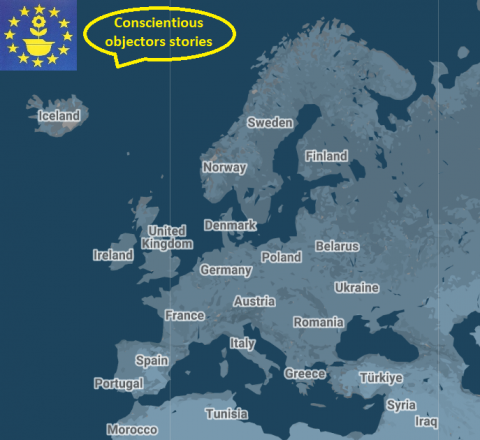
Conscientious objectors stories (videos)
#ObjectWarCampaign

EBCO Newsletter "The Right to Refuse to Kill"



Italy

Previous reports: 2023/24
| Conscription currently imposed? | No |
Suspended under Law 226/2004. Last conscripts demobilised 2005. |
||||||
| Conscientious objection first recognised | 1972 | Act No. 772/1972 | ||||||
| CO release of professional soldiers | – | No specific provisions. | ||||||
| Minimum recruitment age | 18 | |||||||
| Population 1 |
|
|||||||
| Armed forces |
|
|||||||
| Military expenditure |
|
|||||||
Principal EBCO concerns
-
It remains unclear whether the provisions for conscientious objectors would apply to an event of emergency mobilisation.
-
It remains unclear whether the right to conscientious objection is recognised for voluntary or professional soldiers.
Based on information by EBCO's Italian member, Movimiento Nonviolento:2
Developments
In Italy, there is still an ongoing political debate on whether compulsory military service should be reintroduced. In May 2024, Italy's right-wing Lega Party introduced a bill aiming to reintroduce six months of compulsory military or civil service for individuals aged 18-26. The service would be conducted on a regional basis within Italy. Deputy Prime Minister Matteo Salvini stated that the bill offers civil service options for conscientious objectors or those unwilling to perform military service. The proposal emphasizes civic education, discipline, and community service. As of now, the bill has been filed in the Chamber of Deputies but has not yet been enacted into law. Actually, the current Minister of Defence is not supporting such proposals, valuing the contribution of a professional army.
-
Establishment of an Auxiliary State Reserve: The Ministry of Defence is reportedly working on legislation to establish an Auxiliary State Reserve, comprising up to 10,000 volunteers. This initiative aligns with Law No. 119 of 2022, which provided a delegation to the executive to create such a reserve. The reserve would support internal security, disaster relief, and other specific needs, excluding compulsory conscription.
-
Amendments to Law 185/90 on Arms Exports: Discussions are ongoing regarding amendments to Law 185/90, which regulates arms exports. Proposed changes could potentially reduce transparency in arms export authorisations. The data on Italian military exports for 2024, recently transmitted to Parliament through the Annual Report required by Law 185/90, shows that Italy's arms industry is also profiting from the current global context of rearmament. Overall arms export authorisations are significantly increasing, which will result in a major rise in revenues for weapons manufacturers over the coming years through sales to foreign countries.
Conscription provisions and procedures
In Italy, compulsory military service has been suspended, not abolished. This suspension took effect on 1 January 2005, following Law No. 226 of 23 August 2004.
However, the law explicitly states that conscription can be reinstated by government decree in cases of war or national emergency. The provision for the reinstatement of conscription during times of war or national emergencies is maintained under Law 331/2000.
Law No. 226/2004 stipulates that conscription may be reintroduced by decree of the President of the Republic, on the proposal of the Minister of Defence, in the event of a serious international crisis, war, or national emergency. The reactivation process would include determining the cohorts affected and reinitiating the mechanisms of selection and enlistment.
Conscientious objection provisions and procedures
Since conscription has been suspended, there is no obligation to register, and the issue of conscientious objectors refusing registration does not arise in practice. Prior to the suspension, registration occurred at age 18, and conscientious objectors could apply for alternative civilian service.
As there is no legal framework supporting conscientious objection for serving professional personnel, the Italian armed forces do not provide information or guidance on this matter to their members.
Currently, there is no specific legislation in Italy that directly addresses reservists' right to claim conscientious objection after completing initial military service. The general framework for conscientious objection is outlined in Law No. 230 of 8 July 1998, which regulates the right to conscientious objection primarily for conscripts. However, after the suspension of conscription in 2005, the law has not been updated to cover the situation of professional soldiers or reservists. Thus, no formal mechanism exists for a reservist to apply for recognition as a conscientious objector under current Italian law. The lack of explicit legal provisions for reservists creates a legal vacuum in this area.
If conscription were to be reinstated in Italy, the legislation concerning conscientious objection -namely Law No. 230 of 8 July 1998- would also come back into effect. This law remains in force and provides for the recognition of conscientious objector status and would apply even under renewed conscription.
Voluntary recruitment
Currently, the Italian armed forces are composed entirely of volunteers, both male and female, and there is no active registration procedure for military service, as conscription remains suspended.
Voluntary recruitment is primarily governed by:
· Law No. 226 of 23 August 2004: This law suspended compulsory military service and established the framework for a professional, volunteer military force.
· Recent Legislative Amendments: New provisions have been introduced to allow recruits to volunteer for either a fixed term or a three-year term, with specific compensation structures.
On August 28, 2022, Law No. 119 of August 5, 2022,3 amending existing legislation regarding the active contingent of the Italian armed forces, entered into effect in Italy.
The minimum age for voluntary military service in Italy is 18 years; recruits have to be aged between 18-25 years and commit to a minimum of one year of service.
Initial service duration can vary:
· Fixed-Term Contracts: Recruits may serve for a predetermined period, often ranging from 12 months to three years.
· Three-Year Terms: Recent legislative changes have introduced the option for recruits to commit to a three-year term, with compensation set at 80% of that for permanent volunteers.
Specific data on reenlistment rates in Italy is not publicly available.
Although conscription has been suspended, the military reserve, composed of volunteers, continues to exist and can be called upon for internal security duties, disaster relief, or other specific needs, but not for compulsory military service. As mentioned above, according to some sources, the Ministry of Defence is working on a legislation concerning the establishment of an Auxiliary State Reserve comprising up to ten thousand members.
The Italian Armed Forces employ various strategies to attract volunteers. For instance:
Financial incentives: Recruits receive competitive salaries and benefits. As mentioned previously, recent legislative changes allow them to volunteer for varying fixed terms, including a three-year option, with compensation set at 80% of that earned by permanent volunteers.
Career Opportunities: The military offers clear career progression paths, specialized training, and the possibility of transitioning into civilian roles within the defense sector.
Educational Benefits: Scholarships and educational programs are offered, particularly targeting regions with higher unemployment rates, to encourage enlistment.
Advertising Campaigns: The armed forces conduct recruitment campaigns through various media channels, highlighting the benefits and opportunities of a military career.
Asylum for conscientious objectors
As of now, Italy does not publish disaggregated statistics specifically detailing asylum applications or decisions based on claims of conscientious objection. While the Italian asylum system recognizes conscientious objection as a legitimate ground for international protection under the 1951 Geneva Convention—particularly when linked to persecution for political opinions or membership in a particular social group—such cases are typically categorized under broader headings like "political opinion" or "religion". Given the lack of publicly detailed statistics on this specific category, obtaining precise numbers on approvals or rejections of asylum applications citing conscientious objection in Italy is challenging.
Militarisation of the education system
In Italy, participation in military-oriented programs is not formally part of the mandatory secondary education curriculum.
Military personnel are not typically involved in teaching standard academic classes within the Italian public school system. However, they may participate in specific programs or events, such as career days or educational workshops, where they provide information about military careers or conduct demonstrations. These engagements are usually temporary and are intended to inform students about opportunities within the armed forces.
The Osservatorio contro la militarizzazione delle scuole4 has documented instances where military personnel conduct presentations or activities in schools, sometimes without clear consent from students or parents.
These activities are often framed as educational or career-oriented but may serve as indirect recruitment efforts.
There are also military schools that combine traditional education with military training. For example, the Francesco Morosini Naval Military School in Venice enrolls students aged 15 to 18, combining traditional education with military training and maritime activities. Similarly, the Nunziatella Military School in Naples offers a curriculum that includes military discipline and training alongside standard academic subjects. These institutions are designed to prepare students for potential future careers in the armed forces
There is no publicly available evidence indicating that the Italian armed forces have direct access to students' personal data through the education system. However, the Osservatorio contro la militarizzazione delle scuole has expressed concerns about the potential for indirect data collection during military-led school activities. For instance, when students participate in events or programs organized by the military, there may be instances where personal information is collected, raising privacy concerns. The extent and use of such data collection are not well-documented, highlighting the need for greater transparency.
-
Population and armed forces figures are derived from The Military Balance 2025, published by the international Institute for Strategic Studies; military expenditure figures are estimates published by SIPRI (The Stockholm International Peace Research Institute) in April 2025. ⤴
-
More info about the organisation at: https://www.nonviolenti.org/cms/⤴