
Bureau Européen de l'Objection de Conscience | Europäisches Büro für Kriegsdienstve
User login
EBCO report on conscientious objection to military service in Europe 2025 online
How militarised are you?
CoE interactive map
Conscientious objectors stories (videos)
#ObjectWarCampaign

EBCO Newsletter "The Right to Refuse to Kill"
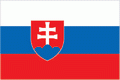
Slovakia
Previous reports: 2023/24
| Conscription currently imposed? | No |
Suspended 2005 (Act 569/2005) Could be reinstated in time of war or emergency |
||||||
| Conscientious objection first recognised | 1992 | Civilian Service Act (of Czechoslovakia) No. 18/1992 | ||||||
| CO release of professional soldiers | – | No specific provisions | ||||||
| Minimum recruitment age | 18 | |||||||
| Population 1 |
|
|||||||
| Armed forces |
|
|||||||
| Military expenditure |
|
|||||||
Principal EBCO concerns
-
It is unclear if and how the law on alternative service would apply to an event of emergency mobilisation.
-
No recognition of the right to conscientious objection for professional soldiers.
-
Military-themed activities take place in schools with the involvement of the Armed Forces.
Developments
In 2024, the government introduced military themed training in primary schools and initiated a “dual education” project with the secondary vocational school of Sečovce. See “Militarisation of the education system” below for details.
In recent years, tens of thousands have submitted applications for recognition as conscientious objectors following the Russian invasion in Ukraine in 2022 and false reportings about imminent mobilisation in Slovakia.2 Opinion polling has shown low willingness of the population to take up arms in the event of a mobilisation.3
The Defence Minister has stated that the Government doesn't wish to reintroduce conscription or compulsory military service.4
Conscription provisions and procedures
Conscription was abolished in 2005. However, Article 25 paragraph 1 of the constitution still reads “The defence of the Slovak Republic is a duty and a matter of honour for citizens. The law shall lay down the scope of the compulsory military service”.5 Conscription in times of crisis or war is regulated by Law 570/2005.6
Conscientious objection provisions and procedures
The right to conscientious objection is recognised in Article 25 paragraph 2 of the Constitution, “No one shall be forced to perform military service if it is contrary to his or her conscience or religion. A law shall lay down the details.”7
Recognition for conscientious objectors and alternative service are regulated by Law 569/2005. Citizens can apply for recognition as conscientious objectors but not during periods of crisis (para. 4, point 2).8
Voluntary recruitment
Slovak citizens aged 18 or over can voluntarily be recruited into the Armed Forces.9
Conscientious objection during and after military service
Military personnel can file requests for release but no specific guarantees are provided when requested on grounds of conscientious objection.10
Asylum for conscientious objectors
No information was available.
Militarisation of the education system
On September 18, 2024, the Ministry of Defence and the Slovak Towns and Municipalities Association signed a Memorandum of Understanding on “encouraging advancement of military themed training and sporting activities in primary schools”.11 This would involve “education programmes, workshops, military themed training and sporting activities to develop pupils' physical fitness, teamwork, and basic life protection skills”. The Ministry of Defence representative stated that “while encouraging playful learning, we will introduce them to the Armed Services environment and the specifics of the military profession”. Primary schools in Slovakia are typically attended by students of ages 6-15.
On October 4, 2024, a “dual education” project was announced to be implemented in the Personal and Property Security Study Programme of the secondary vocational school of Sečovce with the involvement of Ministry of Defence. According to the announcement, the aim of the cooperation would be to “increase the number of those interested in studying in this field and subsequently in serving in the Armed Forces”.12 The students attending secondary education in Slovakia are typically of ages 15-19.
-
Population and armed forces figures are derived from The Military Balance 2025, published by the international Institute for Strategic Studies; military expenditure figures are estimates published by SIPRI (The Stockholm International Peace Research Institute) in April 2025. ⤴