
Bureau Européen de l'Objection de Conscience | Europäisches Büro für Kriegsdienstve
User login
EBCO report on conscientious objection to military service in Europe 2025 online
How militarised are you?
CoE interactive map
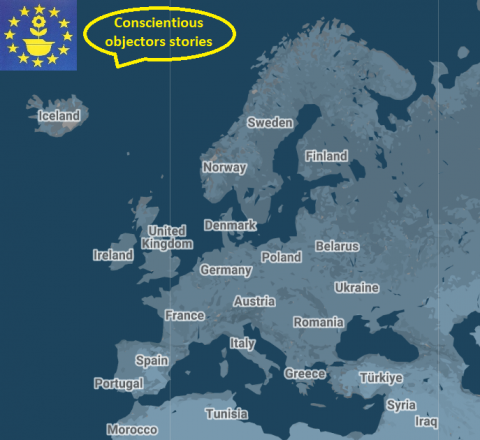
Conscientious objectors stories (videos)
#ObjectWarCampaign

EBCO Newsletter "The Right to Refuse to Kill"



Türkiye

Previous reports: 2024 | 2023/24
| Conscription currently imposed? | Yes | |||||||
| Conscientious objection first recognised | Never recognised | |||||||
| Current provisions | ||||||||
| Duration |
|
|||||||
| CO release of professional soldiers | Not permitted | |||||||
| Minimum recruitment age | 19 | |||||||
| Military expenditure1 |
|
|||||||
Principal EBCO concerns
-
No recognition of the right to conscientious objection. Prolonged violation of the European Convention on Human Rights, the ICCPR, and relevant rulings.
-
Prosecution and punishment of conscientious objectors with interference to a wide range of human rights amounting to civil death, and repeated punishments in violation of ne bis in idem.
-
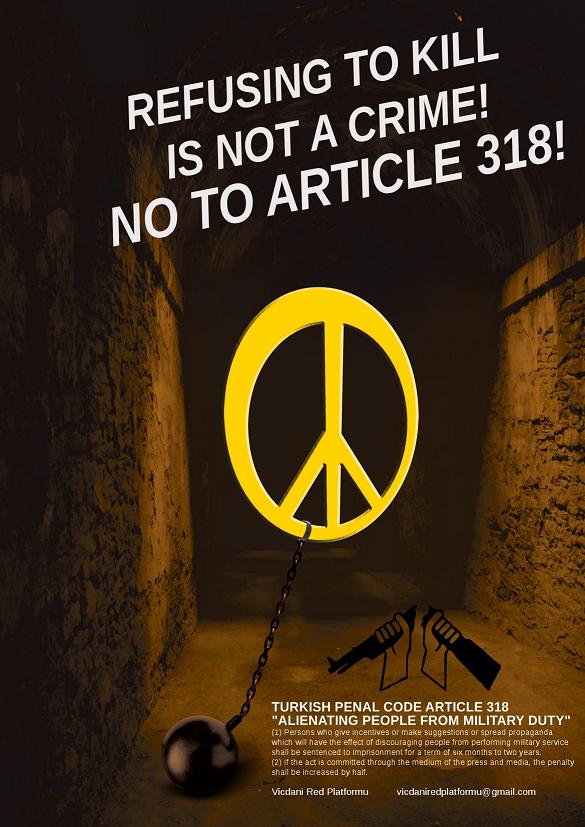
Criminalisation of acts deemed to “alienate the public from military service.”
As reported by EBCO’s Turkish member, the Conscientious Objection Watch:2
Developments
Constitutional Court ruling: In 2025, the Court decided that repeated prosecutions of draft evaders, including of conscientious objectors, do not violate the ne bis in idem principle.3 This ruling effectively legitimised the practice of subjecting objectors to multiple prosecutions and sentences for the same underlying refusal, contradicting international human rights standards under the ICCPR and ECHR.
Escalation of repeated prosecutions: Multiple objectors, including Kamil Murat Demir,4 Çınar Koçgiri Doğan,5 and İnan Mayıs Aru,6 received new prison sentences in 2025, often after having already served previous sentences for the same refusal. Courts explicitly cited their persistent conscientious objection as criminal behavior.
Continued reliance on restrictive provisions: Articles 318 and 217 of the Turkish Penal Code remain in force, criminalising expressions that “alienate the public from military service” or “incite disobedience.” These provisions continue to be applied against objectors and anti-militarist activists, despite ECtHR jurisprudence finding them incompatible with freedom of expression. In this context, Şendoğan Yazıcı7 was sentenced to seven months and fifteen days’ imprisonment for expressions related to conscientious objection. His case remains pending on appeal.
Economic punishment and financial coercion: Objectors such as lawyer Gökhan Soysal8 faced severe fines (over 210,000 TL) and confiscation of bank accounts, preventing them from exercising their professions and meeting basic living expenses.
Civil death continues: Objectors remain excluded from public employment, social security, higher education, voting rights, and freedom of movement. In 2025 alone, 45 individuals reported to Conscientious Objection Watch that they were unable to exercise basic rights due to their CO status.

Parliamentary activity: Questions concerning individual objectors continue to be dismissed with formulaic references to the Law on Military Service, reflecting a deliberate refusal to engage with the substance of conscientious objection claims.
Conscientious objection provisions and procedures
Domestic law still provides no mechanism for conscientious objectors to apply for recognition or to perform civilian service. Paid military service remains the only alternative, but it requires one month of basic military training.
State institutions continue with punitive practices:
-
Military recruitment offices issue negative responses to conscientious objection petitions, citing the absence of any legal basis for exemption.
-
Courts increasingly rely on prior convictions of objectors as evidence of a “tendency to commit crimes,” thereby justifying harsher sentences and refusing reductions or suspension measures.
-
Administrative bodies have expanded the use of financial sanctions, including fines and freezing of bank accounts, as a form of coercion against objectors.
The landmark Ülke v. Türkiye case9 remains unimplemented in substance. Osman Murat Ülke continues to be classified as a deserter and subjected to repeated notifications and threats of prosecution, demonstrating Türkiye’s ongoing failure to comply with binding ECtHR rulings.
Despite recent calls by the Committee of Ministers of the Council of Europe and the UN Human Rights Committee to end the violation of Articles 3 and 9 of the ECHR and Articles 18 and 14 of the ICCPR that comes from refusing to recognise conscientious objection, the state has taken no steps to bring domestic law in line.
This legal gap has produced a persistent pattern of harassment, with conscientious objectors subjected to long-lasting cycles of prosecutions, convictions, and re-prosecutions. The Constitutional Court’s ruling institutionalising such repeated punishment marks a serious regression, legitimising judicial harassment and reinforcing “civil death” that excludes objectors from civil, political, and social life.
- Military expenditure figures are estimates published by SIPRI (The Stockholm International Peace Research Institute) in April 2026.↩︎
- More info about the organisation at: https://vicdaniret.org↩︎
- https://www.resmigazete.gov.tr/eskiler/2025/12/20251229-20.pdf [in Turkish]↩︎
- Tunceli 1st Criminal Court of First Instance, 2025/104 E., Pertek Criminal Court of First Instance 2025/384 E.↩︎
- 3 Sivas 3rd Criminal Court of First Instance, 2023/276 E; and 2025/18 E.↩︎
- Kütahya 3rd Criminal Court of First Instance, 2025/169E., and 2025/504 E.↩︎
- Borçka Criminal Court of First Instance, 2024/233 E↩︎
- Sivas Military Recruitment Office, No:2025/6154, 28.05.2025↩︎
- https://hudoc.echr.coe.int/eng?i=001-72146↩︎