
Bureau Européen de l'Objection de Conscience | Europäisches Büro für Kriegsdienstve
User login
EBCO report on conscientious objection to military service in Europe 2025 online
How militarised are you?
CoE interactive map
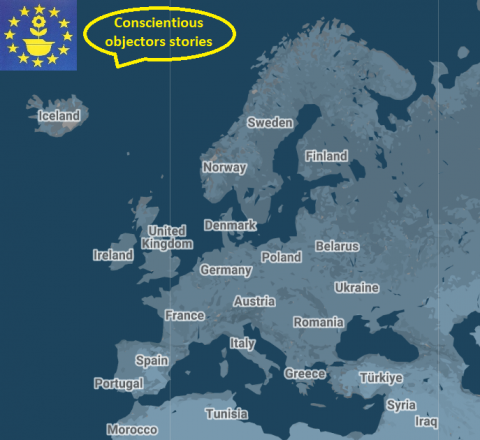
Conscientious objectors stories (videos)
#ObjectWarCampaign

EBCO Newsletter "The Right to Refuse to Kill"


Ukraine

Previous reports: 2023/24
| Conscription currently imposed? | Yes | |||||||
| Conscientious objection first recognised | 1991 |
Alternative (Non-Military) Service Law No. 1975-XII of 12th December 1991 |
||||||
| Current provisions | Not recognised | Alternative service was suspended under martial law, attempts to reintroduce it were blocked by MoD. | ||||||
| Duration |
|
|||||||
| CO release of professional soldiers | Not permitted | |||||||
| Minimum recruitment age | 18 (voluntary), 25 (compulsory) | Admission to the state military HEIs from 17 (considered military service), to military lyceums from 6-7 | ||||||
| Population 1 |
|
|||||||
| Armed forces |
|
|||||||
| Military expenditure |
|
|||||||
Principal EBCO concerns
-
There are prisoners of conscience such as Mykhailo Adamovych, Vladyslav Bezsonov, Taras Bratchenko, Tymur Chyzhov, Serhii Ivanushchenko, Andrii Khomenko, Andrii Kliuka, Vitalii Kryushenko, Serhii Nechayuk, Ihor Nosenko, Oleksandr Radashko, Serhy Semchuk, Andrii Skliar, Oleksandr Solonets, Vasyl Volosheniuk and it is urgent their immediate release, as much as the release of all conscientious objectors imprisoned in penal institutions or detained in military units, convicted or held in pre-trial detention; it is also concerning that some conscientious objectors are indicted in various crimes, where these persecutions are imposed solely for their religion or belief.
-
Imposition on society of the ideology of everyone's duty to fight defensive war in the army or supporting the army with intolerance to and suppression of the pacifist dissent, that undermines pluralism of religions and beliefs and democratic civilian control. Lack of serious consideration of offers of conscientious objectors to contribute by nonviolent action and peaceful work to the resilience of democratic civil society suffering from attacks of the Russian army.
-
Withdrawal during the current state of war of all recognition, and prior lack of full recognition, of the right to conscientious objection to military service, before, during, or after military service, irrespective of the beliefs on which the objection is based, or belonging to churches or other organisations. Lack of efforts to introduce legislation on alternative nonmilitary service in times of war in parliament and interdepartmental working group tasked to draft the amendments.
-
Punishment of conscientious objectors continues through persecution, discrimination, or even torture and inhumane treatment, as well as hostile media campaigns. In accordance with a dictum of the Supreme Court, conscientious objection is treated as draft evasion punishable by the law.
-
Forced conscription and compulsory military registration practices (“busification”) continue, leading to cases of beating and deaths in military recruitment centers. Those lacking military registration are blocked from access to work, education (higher education institutions), or public services (such as consular services abroad).
-
Russia imposes military registration and conscription, pushes military indoctrination of children at schools, propagates and pressures for enlistment at the illegally occupied territories of Ukraine contrary to Article 51 of the IV Geneva Convention. Among 183 Jehovah's Witnesses detained by Russia for their beliefs, including conscientious objection, 14 of the prisoners of conscience are detained in Crimea.2
-
Complaints of unconstitutionality of legislation allowing punishment for conscientious objection, discriminating objectors and denying in alternative service in wartime are stalled at the Constitutional Court, which is currently not able to decide cases on the merits due to delays in appointing new judges.
-
Ukrainian refugee males of conscription age are facing attempts to force them to return to Ukraine or be deported by denial in consular services for not updated military registration and absence of Reserve+ military app on their smartphones, without exceptions for conscientious objectors. That might require European states to recognize expired Ukrainian passports.
Developments
-
Despite harsh mobilisation measures introduced in 2024, tens of thousands managed to cross the border illegally, and more than 6 millions did not undergo mandatory military registration.
-
As covered in the International Section, above the Office of the United Nations High Commissioner on Human Rights reported imprisonments, intimidation and torture of conscientious objectors.3 Under the Special Procedures, a request of information was made on the persecution of Vitalii Alekseienko, of Andrii Vyshnevetskyi for refusing to perform military service and Yurii Sheliazhenko for advocating for the right to conscientious objection, and was met with a contradictory reply.4
-
War Resisters' International in cooperation with Connection e.V. and the Ukrainian Pacifist Movement reported compulsion for military registration and service in the Russian army at occupied territories of Ukraine, arbitrary detentions, tortures, and executions, militarisation of minors contrary to Article 51 of the IV Geneva Convention.
-
New mobilisation laws adopted on 11 April and 9 May 2024 enforce mandatory registration for military recruitment of all males 18 to 60 years of age, under penalty of sanctions, fines, and civil rights restrictions; in addition, the ban on leave the country continues for males in this age group; The public space is dominated with a stigma against those refusing to engage in war, and shame on "draft evaders"; conscientious objectors continue to be labelled as "evaders" in the media; protests against human rights violations related to mobilisation are regularly portrayed as “Russian propaganda”. People who criticise such violations are in many cases accused of dissemination of national security sensitive information about mobilisation practices and locations of forceful street recruitment, charged under Article 114-1 of the Criminal Code (interference with legal activities of Armed Forces of Ukraine), punishable with a prison term from 5 to 8 years; protests against abuses by military recruiters, such as happened in June-August 2024 in Odessa, Kovel and Vorokhta, ended with criminal charges against protesters, administrative arrests, and fines;
-
EBCO Board member Yurii Sheliazhenko - held under house arrest in August 2023 - February 2024 - continues to live under threat of imprisonment, while trial continues where he is falsely accused in “justification of Russian aggression” in a public statement in September 2022 where the invasion was condemned with a call to nonviolent resistance. Amnesty International reports that such charges are extensively used to disproportionately restrict freedom of expression. His communications related to human rights defending consultations to conscientious objectors were surveilled. His computer and smartphone, seized without any legal reasons during a search in his house, were not returned contrary to a court order, and another dubious order was obtained to circumvent the first one. Regarding these events and house arrest, he complained to the European Court of Human Rights. It is also of concern the reporting that there is an attempt to prohibit and dissolve the Ukrainian Pacifist Movement, and that the national media regulator refused to register Sheliazhenko's website "Free Civilians. Herald of Peace and Conscientious Objection".5
-
While according to official statistics in 2023 one of ten sentenced for draft evasion received a real prison sentence and the rest suspended sentences, in 2024 the number of prison sentences increased twice and proportion changed to one of three. 618 were sentenced for draft evasion, 737 for disobedience, 63 for draft evasion by self-harm (the number increased twice from previous year), 928 for absence without leave, 171 for desertion; it is unknown what proportion of sentences for draft evasion and other crimes related to refusal of military service might be related to conscientious objectors.6
-
New legislation was adopted regarding lowering the mobilisation age from 27 to 25 years and harsh enforcement of military registration and conscription, including fines and other sanctions, giving the military right to check IDs and requirement to all men in age 18-60 to bear military IDs, etc. According to the Ukrainian Parliament Human Rights Commissioner's report of 2024, "a number of the Commissioner's recommendations were not taken into account when adopting the Bill 10449, which led to the assignment of inappropriate functions to military units and resulted in significant violations of the rights of Ukrainian citizens during mobilisation." The report also mentions 1,560 complaints on human rights violations during the mobilisation, deaths and beating at military recruitment centers, refusals of access to legal aid and human rights monitoring, non-implementation of recommendations to change legislation to ensure alternative non-military service.7 However, in a letter to EBCO the Secretariat of the Commissioner claimed that the Constitution of Ukraine must be changed, and that it could not be changed in wartime, to ensure the right to conscientious objection, and emphasized that advocacy of such a right is a threat to national security.
-
Military registration for the purposes of conscription in young age was eased with the abolition of the requirement to undergo military medical commission in age 16-25 for military registration.
-
The new law requires of Ukrainians abroad up-to-date military registration of males in age 18-60 for access to consular services, that in effect prevents reissuance of expired passports and forces the people to return to Ukraine or live abroad illegally and risk deportation. Activists filed a petition with the European Parliament asking for recognition of expired passports.8
-
For military registration, mandatory installation of military app Reserve+ on smartphones is required; in Ukraine, it is checked during raids and in encounters with officials, and abroad it is required for consular services. Procedure for maintaining the Unified State Register of Conscripts, Military Enlisted Persons and Reservists "Oberig" (including regulations on functions of the Reserve+ app as “electronic cabinet”), adopted by the Cabinet of Ministers of Ukraine on 10 May 2024, is classified and not published9, raising concerns regarding safety of personal data, privacy and human rights.
-
"Term-limited military service" was replaced with mandatory "basic military" "service" (for all males in age 18-24) and "training" (for students) in the law on military duty. The law on alternative service, which currently allows civilian service only in place of the "term-limited" category of service, was not similarly amended. This formalism could mean the effective abolition of alternative service even after martial law ends.
-
The basic military training became mandatory for all students, and refusal to undergo it could result in expulsion.
-
By the letter of the Ministry of Education, the higher education institutions were instructed to enroll students only if they renewed military registration.
-
Students could be conscripted, if they are expelled or don't prolong deferral, that might happen due to problems with arbitrariness in procedure.
-
Young people in age 18-24 are offered incentives to enlist voluntarily in contract military service.
-
The Ukrainian government requested assistance from European states in returning Ukrainian male refugees for conscription at home. The Ministry of National Unity was established, it works on opening the Unity Hubs in European countries to convince the refugees to return. Ukraine asked Germany to extradite a conscientious objector, and in this context a questionable judgment was made that, contrary to international human rights standards, claims the possibility of limiting the right to conscientious objection in wartime.10
-
In response to EBCO, the Ministry of Defense of Ukraine admitted that conscientious objection is not allowed under martial law and conscientious objectors are persecuted. The Ministry also informed that the interdepartmental working group, which lacks civil society representatives, is developing a draft law to protect the constitutional right to alternative nonmilitary service in wartime. The group first met at the end of 2024, but hasn't made its activities public nor proposed any policy changes yet.
-
In December 2024, the Cabinet of Ministers of Ukraine amended regulations of mobilisation to allow clergy members to be exempt from military service11 in an attempt to placate the churches. This was however based upon classifying clergy as “essential workers”; in no circumstances were the exemptions to be justified by reference to the perceived incompatibility with their vocation of military service12. The amendments did not caused any actual exemptions because the list of eligible religious organisations is not compiled yet13. In discussion groups of conscientious objectors, concerns were raised that this policy might incentivise clergy to refrain from advocacy of full protection of the right of regular believers to conscientious objection. They are also concerned that the Government of Ukraine does not provide any significant support to efforts aimed at nonviolent resistance to Russian aggression and attempts to subordinate it to the army, which undermines the ethical integrity and safety of nonviolent resistance.14
-
The Constitutional Court of Ukraine found admissible a complaint of conscientious objector to military service, Vitalii Alekseienko, and will check alleged unconstitutionality of jailing for three to five years for draft evasion during mobilisation those citizens whose religion or beliefs are incompatible with the performance of military duty (conscientious objectors), and will check also alleged unconstitutionality of requirements for believers to prove in court their innocence in evading the draft, the absence of an alternative non-military service during the war (Alekseienko specifically insist on his right to contribute, legally equal to conscripts, without joining or supporting the army, in a nonviolent Christian way to help Ukraine resist Russian aggression) and its inaccessibility to persons who do not belong to privileged religious organisations. However, the Constitutional Court is dysfunctional and lacks judges to consider the case on the merits.15 Meanwhile, despite that the appellate court in 2024 and the Supreme Court in 2025 refused to jail Alekseienko again, as the prosecutor requested, and upheld his suspended sentence, in a new disturbing judgment the Supreme Court upheld prison sentence for Jehovah's Witness Serhii Ivanushchenko, opining that everyone should fight the war.16
In June, the Court of Cassation rejected the final appeal by Seventh-Day Adventist Dmytro Zelinsky, at the time the only imprisoned conscientious objector, against his conviction and imprisonment under Article 336 of the Criminal Code ("Refusing call-up for military service during mobilisation or in a special period, and for military service during call-up of reservists in a special period"). Deputy General Prosecutor Ihor Mustetsa subsequently sent a letter interpreting the verdict to the heads of all Regional Prosecutor's Offices; it stated “no religious beliefs can be the basis for a citizen of Ukraine, recognised as fit for military service, to evade mobilisation in order to fulfil his constitutional duty to protect the territorial integrity and sovereignty of the state from military aggression by a foreign country”.17
It appears that, following this, systematic attempts were made to recruit into the military members of the minority religious denominations who had in peacetime qualified for alternative civilian service. The number of refusals prosecuted under Article 336, which stipulates a penalty of imprisonment for a period between three and five years, consequently also increased, dwarfed however by the numbers of potential recruits who were being pursued for attempted evasion of mobilisation on grounds other than of conscience.
As detailed below, at least 5 conscientious objectors were or are serving three year prison sentences under Article 336 (“draft evasion”), and at least 4 under article 402 (“disobedience”) of Criminal Code of Ukraine, in known to us and internationally publicized cases (actual number is higher and unknown; total numbers of real prison sentences under these articles in reported period were 179 and 45 respectively), similar sentences had been pronounced but not yet executed in at least twelve further cases, at least three of them confirmed on appeal, a minimum of 182 cases were ongoing in the courts and 582 further criminal investigations of Jehovah's Witnesses alone had been launched. Additionally, at least 4 Jehovah's Witnesses and at least one Seventh-day Adventist were or are jailed in pre-trial detention.
Many objectors were also forcibly taken to military units (contrary to the applicable regulations), effectively detained, where their refusal to bear arms or to don uniform sometimes resulted in prosecutions for insubordination under military law, treating them as members of the armed forces. Details of tenths of these cases are also given below and represent a small part of hundreds of such cases known in local Churches.
Legal challenges
As we reported last year, an appeal made to the Supreme Court by Andrii Vyshnevetsky, who had been forcibly conscripted and sent to the front line where he insisted on serving in an unarmed capacity, was rejected on 23rd February 2024. An application on his behalf (No.20802/04) was lodged by the Ukrainian Pacifist Movement with the European Court of Human Rights on 12th July 2024, alleging a violation of Article 9 of the European Convention on Human Rights. Among other things, it complains of "non-recognition of human right to conscientious objection to military service, absence of access to alternative service instead of compulsory military service under martial law, and denial of the judiciary to remedy that".
On 13th June, the Supreme Court rejected the final appeal by Dmytro Zelinsky against his conviction and sentencing under Article 336. Having thus exhausted domestic remedies, he too subsequently applied to the European Court of Human Rights. Meanwhile, he has launched a challenge before the Constitutional Court to the denial of the right of conscientious objection to military service under martial law. The Court began hearing the petition on 13th October; on 4th December it requested an amicus brief from the Council of Europe's Venice Commission; this was delivered in March 2025,18 outside the period covered by this Report while the decision of the Court is still pending.
A further application to the European Court of Human Rights has been lodged by Mykhaylo Yavorsky, whose sentence of imprisonment had in October 2023 been reduced to a suspended sentence. He claims that his suspended sentence punished him "for his legitimate exercise of human right to conscientious objection to military service protected by Article 9 of the Convention". Yavorsky had also tried to challenge the constitutionality of his conviction before the Constitutional Court, which however on 4th September 2024 issued a final refusal to hear the case on its merits.
Cassation appeals to the Supreme Court are also pending from imprisoned Jehovah's Witnesses conscientious objectors Vitalii Kryushenko and Andrii Khomenko (see below). Both are being held in a temporary detention centre in Sumy pending the hearing of these appeals, for which no dates have yet been set.
Conscription provisions and procedures, denial in recognition, penalisation of conscientious objection
According to the response of the Ministry of Defense of Ukraine to EBCO's questionnaire19, the general principles of military service in Ukraine are determined by the Law of Ukraine "On Military Duty and Military Service". According to the Decrees of the President of Ukraine dated 24 February 2022 No. 64/2022 "On the introduction of martial law in Ukraine" (as amended) and dated 24 February 2022 No. 65/2022 "On general mobilisation", martial law is in effect in Ukraine and general mobilisation measures are being carried out. Duties of Ukrainian citizens during general mobilisation events are specified in Article 22 of the Law of Ukraine "On Mobilisation Preparation and Mobilisation". The minimum age for contract service is 18 years. The minimum age for conscription is 18 years. The duration of military service is determined according to the category of service, in particular: by conscription during mobilisation - until the end of the special period; according to the contract, the term is determined in accordance with the signed contract. The Cabinet of Ministers of Ukraine, by Resolution No. 560 dated 16 May 2024, approved the Procedure for conscripting citizens into military service during mobilisation, for a special period. Conscientious objectors are not exempted from military duty during mobilisation. Evasion from military service is punishable, including, by criminal liability stipulated by the Criminal Code of Ukraine, in particular: Article 336 - evasion of conscription for military service during mobilisation, for a special period, for military service by conscription of reservists in a special period. Replacement of military service with alternative (non-military) service during martial law is not provided for by Ukrainian legislation; in particular, Article 23 of the Law of Ukraine "On Mobilisation Training and Mobilisation" does not provide for the religious beliefs of citizens as grounds for exemption from conscription for military service during mobilisation. Currently, the issue of amending the legislation regarding alternative service in wartime is under consideration. Taking into account the repeated appeals regarding the citizens of Ukraine who according to their religious beliefs cannot take up arms, the Cabinet of Ministers of Ukraine mandated the State Service of Ukraine for Ethnopolitics and Freedom of Conscience (hereinafter - DESS) to organize a working group to work out issues related to the development of a separate legal act with the aim of bringing the Law of Ukraine "On Alternative (Non-Military) Service" into compliance with the requirements of Article 35 of the Constitution of Ukraine regarding the performance of military duty by conscripts in wartime, if it conflicts with their religious beliefs. Such a working group of DESS was created, and it includes specialists from the Ministry of Defense of Ukraine, the Secretariat of the Commissioner of the Verkhovna Rada of Ukraine for Human Rights, the Ministry of Justice of Ukraine, the Ministry of Economy of Ukraine, the Ministry of Social Policy of Ukraine, the Ministry of Development of Communities and Territories of Ukraine, the Ministry of Health of Ukraine, the State Emergency Service of Ukraine and the State Agency for Reconstruction and Development of Infrastructure of Ukraine. Consultations and development of legislative proposals regarding alternative (non-military) service during martial law, for a special period, are underway.
Military registration and measures of enforcement, such as forced transportation to military recruitment centers, usually carried out by a group of soldiers forcibly taking a person to a bus (“busification”)20, are applicable to all men in age 18-60. Despite the MoD's letter quoted above says that the minimum age for conscription is 18 years, and cases of conscription in age 18-24 in 2024 are known (including a case where the court ruled that conscription of 19 years old man was illegal21), it should be noted that as a rule, after changes of legislation and internal directives issued in 2024, males in age 18-24 could be conscripted only when they agree, and, differently to older conscripts, they are allowed to choose time of mandatory basic military service; furthermore, if for older conscripts the basic service usually is prelude to mobilisation, in age 18-24 it is prohibited to conscript after mandatory basic military service without the person's consent.
All males in age 16-17 are subject to military registration for the purposes of conscription, and in age 18-60 are required to bear military registration documents that might be checked by police, border guard, military patrols or at checkpoints, as well as by agencies providing public services; the law places on employers, enterprises, educational institutions, etc., duties related to ensure total military registration. In 2024, all males of 18-60 cohort were obliged by the law to update their military registration, and 6 out of 11 millions failed to do so22, thus became subject to fines; however, only 21 336 were fined23. Military registration update includes actualisation of personal data and medical examination, after which those in age 25-60 who found fit and don't claim deferral might be immediately, or later, to be summoned to depart, or forcibly transported, or arbitrarily detained pending forcible transportation to military unit (usually, training center) and start compulsory military service by mobilisation. In many cases medical examination is formality or illegally not conducted. When recruiters assign conscript servicemen status, it is almost impossible to be discharged. Freedom of movement and communication at military recruitment centers and other units is limited, thus people (including conscientious objectors) could be held effectively detained and not allowed to quit at whim of officers. Complaints to commanding officers, police, and courts rarely give any effect, and it is impossible or strongly discouraged to seek legal aid. Usually, the recruiters deceive conscripts with unrealistic promises seeking their cooperation with military registration and conscription procedures; for example, conscientious objectors are usually lied to that it is possible to serve in army without bearing arms, contrary to military statutes that require to bear arms and engage in combat as commanded under threat of severe criminal punishment for disobedience.
The MoD's letter puts conscientious objection in context of the draft evasion. It is not a coincidence but a policy, currently accepted by the courts, to treat conscientious objection like draft evasion punishable by the law. Because of stigma and lack of public awareness, reported in previous EBCO annual reports, only in a small number of cases that potentially might raise issue of the right to conscientious objection to military service, this issue was raised by the defense, and even more rarely the courts mentioned or considered this seriously in judgments; only a few clear and scandalous cases are publicized and became internationally known. Reporting developments in these few cases, we must warn that, as the statistics of prosecution and courts suggests, it might be much more cases of prosecution, pretrial detention, sentencing and imprisonment for conscientious objectors; we are aware about existence of lists of names for prayers for hundreds of persecuted conscientious objectors.
Regulations on compulsory military service, denial in alternative service under martial law, and related constitutional rights
| Legislation | Description |
|---|---|
| Constitution of Ukraine |
Article 9 says that treaties of Ukraine are part of national legislation of Ukraine; it allows conscientious objectors to invoke Art. 4, 18 of ICCPR and Art. 9, 15 of ECHR. Article 24 envisages equality before the law, in particular, on the grounds of religion or belief; it could not be limited in any circumstances, according to Article
replacement of military duty with alternative non-military service when compliance with such contradicts religious beliefs of a citizen. Article 65 envisages a citizen's duty to defend Fatherland. |
| Law of Ukraine “On Military Duty and Military Service” | The law defines military duty (Article 1) setting exemptions for women and saying that it could be replaced with alternative service according to Constitution of Ukraine and Law of Ukraine “On Alternative (Non-Military) Service”; requires military patriotic upbringing of citizens (Article 8) and initial military training as a part of mandatory basic education (Article 9); regulates military registrationfor the purposes of conscription, mandatory basic military service of conscripts and basic military training of students, conscription during mobilisation, voluntary service by a contract, deferrals, exemptions, eligible age, term of service, dismissal, service in reserve, demobilisation, retirement (Articles 14-39). The law allows women, except for medics and pharmacists, to decide whether to agree to be registered, and allows men in age 18-24 to decide whether to agree to be conscripted and in what year before reaching 25 to undergo mandatory basic military service. |
| Decree of the Cabinet of Ministers No 560 of 16.05.2024 | The decree sets procedure of conscription in time of mobilisation, including summoning people for military registration, detention and compulsory transportation to military recruitment centers, etc. |
| Law of Ukraine “On Alternative (Non-Military) Service” | The law in Article 1 allows to limit the right to alternative service in time of national emergency, including war, and defines alternative service in terms that after changes of law on military duty in 2024 became obsolete, effectively allowing no alternative service at all. Article 2 discriminates in access to alternative service by membership in particular religious organisations. Constitutionality of the provisions is contested by complaints of Zelinsky and Alexeienko pending before the Constitutional Court of Ukraine. |
| Law of Ukraine “On Preparation for Mobilisation and Mobilisation” | The law envisages emergency powers of the military and other governmental bodies, including enforcement of conscription during mobilisation. In Article 22 it prescribes duties of citizens, in Article 23 deferrals from conscription are described. |
| Legislation | Description |
|---|---|
| Law of Ukraine “On the Legal Regime of Martial Law” | The law envisages that limitations of human rights under martial law must be exhaustively listed in the presidential decree and that the UN Secretary General must be informed about derogations from the ICCPR. Article 20 says that rights listed in Article 64 (2) of the Constitution of Ukraine shall not be limited. With new amendments, the article requires that all males in age 18-60 must bear with them military ID and provide it for checking. |
| President's Decree № 64/2022 "On the imposition of martial law in Ukraine" | The decree declares martial law from 5.30am 24 February 2022 and limits rights of human and citizen, prescribed by Articles 30–34, 38, 39, 41–44, 53 of the Constitution of Ukraine. It was approved by the law and prolonged during all periods of the reporting according to subsequent decrees and laws. |
| President's Decree № 69/2022 "On general mobilisation" | The decree declares general mobilisation, including conscription. No provisions for conscientious objectors are envisioned. |
Legislation related to persecution of conscientious objectors
| Legislation | Description |
|---|---|
| Criminal Code of Ukraine | Mostly, conscientious objectors are punished for refusal to be conscripted under Articles 336 (evasion of conscription during mobilisation is punishable from 3 to 5 years of incarceration; constitutionality of this provision in aspect of penalizing conscientious objection is contested by complaint of Alexeienko pending before the Constitutional Court of Ukraine), 337 (evasion of military registration or gatherings, punishable by fine up to 250 Euro or correctional labor up to 2 years), 402 (disobedience, punishable by 5-10 years of prison), 407 (unauthorised absence at military unit, punishable by 5-10 years of prison), 408 (desertion, punishable by 5-12 years of prison), 409 (evasion of military service by self-harm or alike, punishable by 5-10 years of prison). |
| Code of Ukraine on Administrative Offences | Mostly, conscientious objectors are punished for refusal to undergo military registration under Article 210 (violation of rules of military registration) and Article 210-1 (violation of defence and mobilisation legislation), both punishable by a fine in sum of 360-540 Euro, that is a significant sum unbearable for many in Ukraine. Those who are trying to escape Ukraine could be punished under Article 204-1 (illegal crossing or attempt to cross the state border, punishable by a fine of 80-200 Euro or administrative arrest up to 15 days). |
| Governmental decree No 1487 of 30.12.2022 | The decree requires a check of military registration documents for employment, education, etc. Non-compliance of individuals and institutions is punishable by administrative and criminal penalties. |
Number of persons, sentenced by courts for crimes related to evasion of military service in Ukraine24
| Art. of Criminal Code of Ukraine / Year | 2024 | 2023 | 2022 | 2021 | 2020 | 2019 | 2018 | 2017 | 2016 | 2015 | 2014 | 2013 | 2012 |
|---|---|---|---|---|---|---|---|---|---|---|---|---|---|
| 332 (illegal smuggling of people across state border of Ukraine) | 247 | 191 | 120 | 60 | 48 | 54 | 65 | 68 | 61 | 69 | 102 | 95 | 73 |
| 336 (evasion of conscription during mobilisation) – total number (incl. suspended sentences) above, number of incarceration sentences below in italic |
618 179 |
930 86 |
186 14 |
2 0 |
1 0 |
11 0 |
13 1 |
45 1 |
220 10 |
935 49 |
139 7 |
0 0 |
0 0 |
| 337 (evasion of military registration or gatherings) | 291 | 28 | 12 | 34 | 73 | 156 | 110 | 21 | 3 | 2 | 0 | 0 | 0 |
| 402 (disobedience) | 737 | 689 | 155 | 9 | |||||||||
| 407 (unauthorised absence at military unit) | 928 | 1577 | 1036 | 1407 | 1506 | 2189 | 2267 | 2128 | 1937 | 1545 | 153 | 22 | 29 |
| 408 (desertion) | 171 | 113 | 154 | 220 | 152 | 239 | 224 | 381 | 307 | 171 | 29 | 2 | 1 |
| 409 (evasion of military service by self-harm or alike) | 63 | 32 | 19 | 8 | 8 | 3 | 3 | 6 | 25 | 92 | 23 | 11 | 11 |
Monthly cumulative number of criminal investigations of crimes of types, that might be alleged for penalisation of conscientious objection25
| Article of Criminal Code / Month of 2024 | 336 | 337 | 402 | 407 | 408 | 409 |
|---|---|---|---|---|---|---|
| January | 459 | 35 | 197 | 2159 | 1289 | 25 |
| February | 845 | 87 | 375 | 4697 | 3364 | 39 |
| March | 1161 | 138 | 505 | 7269 | 5507 | 61 |
| April | 1477 | 191 | 667 | 10584 | 7306 | 79 |
| May | 1875 | 252 | 866 | 15195 | 9623 | 100 |
| June | 2271 | 258 | 990 | 19607 | 11272 | 134 |
| July | 2736 | 310 | 1174 | 24566 | 13273 | 160 |
| August | 3218 | 348 | 1293 | 29148 | 15499 | 192 |
| September | 3458 | 382 | 1402 | 34329 | 18126 | 220 |
| October | 3805 | 440 | 1541 | 41950 | 19922 | 230 |
| November | 4094 | 480 | 1699 | 50729 | 21127 | 245 |
| December | 4147 | 476 | 1849 | 66240 | 23209 | 256 |
Prosecutions of conscientious objectors under Article 336
The table below shows the information we have been able to gather from lists published at various times,26 of criminal cases launched against conscientious objectors under Article 336 since the Russian invasion. Proceedings often involved multiple court appearances; we have quoted, to the best of our knowledge, only the first occasion on which each case came to court. Most first instance verdicts were appealed by the defence, the prosecution, or sometimes both; even after taking effect with the rejection a final appeal sentences of imprisonment were not always implemented immediately, sometimes perhaps because of prison overcrowding. It is important to note that some cases were not included to the table because of incomplete or contradictory information about defendant's religion or beliefs, or, to our knowledge, too partial, vague or uncertain character of declared objection, where defendants just stated that they refuse to kill (or, in one case of a convicted man born in Russia, refuse to kill his own people) without references to religious or philosophical commitments, perhaps not demonstrating enough seriousness of their beliefs and not asking for alternative nonmilitary service. Media reporting and judgments might be distorted by overlooking human rights concerns, and objectors might not be aware fully about their rights, thus difficulties in finding and researching all relevant cases.
The table illustrates the rapid and accelerating deterioration in the situation in the course of 2024, which went almost unnoticed at the time. Until March the “normal” verdict had been the imposition of a suspended sentence, with a few outright acquittals. The two sentences of imprisonment handed down by the first instance courts had been changed on appeal to suspended sentences. Only Dmytro Zelinsky, whose acquittal had been overturned on appeal, was imprisoned.
Subsequently, all verdicts announced with just two exceptions have been of three year sentences of imprisonment. (One suspended sentence was handed down in May, and news has come in of an acquittal in March 2024.) Three years is the minimum sentence stipulated under the Article. The first Jehovah's Witness to be imprisoned went to jail in January 2025; previously the courts, recognising their obvious sincerity, had taken pains to impose lesser penalties on Jehovah's Witnesses.
Without a dramatic change in sentencing policy, it seems that by the end of 2025 much more than 17 conscientious objectors currently under sentence of imprisonment will be in jail; meanwhile there is no sign that the wave of investigations has yet peaked; with over 100,000 Jehovah's Witnesses alone in Ukraine, and 500,000 members of all pacifist churches, as indicated below, it could have a long way to go, and be mirrored months later by similar waves of convictions and imprisonments.
This table reflects only rare internationally publicized cases of persecuted conscientious objectors, the real number is much higher.
| Year | Month | First trials | Successful appeals |
Acquittals/ Suspended sentences |
Sentences of imprisonment | COs in prison | |
|---|---|---|---|---|---|---|---|
| Defence | Prosecution | ||||||
| (cumulative totals) | |||||||
| 2022 | May | 1 | 1 | ||||
| June | 1 | 2 | |||||
| July | 0 | 2 | |||||
| August | 2 | 4 | |||||
| September | 2 | 4 | 1 | ||||
| October | 1 | 4 | 1 | ||||
| November | 0 | 4 | 1 | ||||
| December | 0 | 5 | 1 | ||||
| 2023 | January | 1 | 5 | 1 | |||
| February | 1 | 6 | 1 | 1 | |||
| March | 1 | 7 | 1 | 1 | |||
| April | 3 | 7 | 2 | 1 | |||
| May | 1 | 1 | 1 | 7 | 1 | 0 | |
| June | 2 | 7 | 1 | 0 | |||
| July | 1 | 7 | 1 | 0 | |||
| August | 0 | 1 | 7 | 2 | 0 | ||
| September | 1 | 8 | 2 | 0 | |||
| October | 2 | 1 | 11 | 1 | 0 | ||
| November | 0 | 11 | 1 | 1 | |||
| December | 1 | 12 | 1 | 1 | |||
| 2024 | January | 1 | 13 | 1 | 1 | ||
| February | 0 | 13 | 1 | 1 | |||
| March | 2 | 13 | 3 | 1 | |||
| April | 0 | 13 | 3 | 1 | |||
| May | 3 | 14 | 4 | 1 | |||
| June | 3 | 14 | 4 | 1 | |||
| July | 4 | 14 | 7 | 1 | |||
| August | 1 | 14 | 8 | 1 | |||
| September | 2 | 14 | 10 | 1 | |||
| October | 9 | 14 | 11 | 1 | |||
| November | 35 | 14 | 13 | 1 | |||
| December | over 182 | 14 | 15 | 1 | |||
| 2025 | January | 14 | 16 | 2 | |||
| February | 14 | 16 | 4 | ||||
| March | 15 | 17 | 5 | ||||
In so far as we have a date when proceedings were first initiated, it seems also that cases are coming to court more rapidly, as the following table shows. (Our information may not be completely accurate; we certainly do not have dates of all court hearings.) The most rapid of which we have a record was the case of one of the two Jehovah's Witnesses identified as Yurii S., against whom police instituted criminal proceedings on 10th October 2024, and who appeared for the first time in Zhmerynka District Court, Vinnitsa Province, on 5th November. Earlier, Serhii Ivanushchenko had been convicted by Bilopia Court, Sumy Province, on 28th March, just over a month after proceedings had been initiated against him.
| Months since proceedings initiated | First coming to court | ||
|---|---|---|---|
| January−September 2024 | October 2024 | November 2024 | |
| 1 | 1 | 2 | 4 |
| 2 | 1 | 2 | 5 |
| 3 | 1 | 14 | |
| 4 | 1 | 2 | |
| 5 | 2 | 3 | |
| 6 | 2 | 1 | |
| 7 | 1 | 1 | |
| 8 | 2 | ||
| 9 | 1 | ||
| 10 | |||
| 11 | |||
| 12 | |||
| 13 | 1 | ||
| TOTAL | 8 | 8 | 32 |
By contrast two Jehovah's Witnesses cases resulting from investigations initiated in April 2023, and which had first come to court in the middle of that year (those of Viktor M. and Vitalii P.) ultimately resulted in convictions (before any appeal) in September and November 2024, respectively, and the case of a further Jehovah's Witness, Ibrahim S., against whom proceedings had been initiated on 25th July 2023, and which came before Boryspil Court in Kyiv on 14th May. 2024 has, as far as we know, yet to result in a verdict. Likewise, the latest news of the case 53-year-old Baptist Konstantyn Chovgan, who refused a call-up order on 17th November 2023, is that a further hearing was scheduled for 18th March 2024. And in the case of Jehovah's Witness Viktor S., on 4th March 2022 one of the first conscientious objectors to be subjected to criminal proceedings after the Russian invasion, Zakarpattia Court of Appeal on 20th May 2024 overturned the original acquittal handed down by Tiachiv District Court on 20th March 2023, and ordered a retrial, which, to the best of our knowledge, is still pending. Another prosecution appeal against a verdict of Tiachiv District Court, the (four year) suspended sentence handed down on 24th October 2023 to Volodymyr Ukhal, the only member of the Orthodox Church to have been hitherto prosecuted as a conscientious objector, is also still ongoing; the latest news was that a hearing was scheduled for 7th April 2025.
We do not have yet have details of all cases which have come to court since November; in early March, Forum 18 reported that no fewer than 171 cases were currently in the courts against Jehovah's Witnesses, and named nine Baptists (one of whom has subsequently been acquitted), two Adventists, and one Pentecostalist against whom cases were also ongoing.
The oblasts (provinces) in which trials have taken place are shown in the table below, listed roughly from West to East.
| Oblast | Population (millions) |
Cases and verdicts A–acquittal / S–suspension X–imprisonment |
Cases per million | A & S% | X% | ||
|---|---|---|---|---|---|---|---|
| 2022/3 | 2024 Jan–Oct |
2024 Nov–Dec |
|||||
| Zakarpattia | 1.4 | 6 AASS | 4.3 | 67 | 0 | ||
| Lviv | 2.5 | 1 X | 4 | 2.0 | 0 | 20 | |
| Ivano-Frankivsk | 1.4 | 4 SSXX | 2.9 | 50 | 50 | ||
| Volyn | 1.0 | 1 | 3 X | 4.0 | 0 | 25 | |
| Ternopil | 1.0 | 3 XX | 3.0 | 0 | 67 | ||
| Rivne | 1.1 | 3 | 2.7 | 0 | 0 | ||
| Khmelnytskyi | 1.2 | 2 | 1.7 | 0 | 0 | ||
| Odesa | 2.4 | 2 S | 4 X | 2.5 | 17 | 17 | |
| Vinnytsia | 1.5 | 1 S | 1 | 1.3 | 50 | 0 | |
| Zhytomyr | 1.2 | 5 X | 4.1 | 0 | 20 | ||
| Kyiv | 4.8 | 2 A | 2 X | 4 | 1.7 | 12.5 | 12.5 |
| Chernihiv | 1.0 | 1 | 1.0 | 0 | 0 | ||
| Cherkasy | 1.2 | 1 | 10 | 9.1 | 0 | 0 | |
| Kirovohrad | 0.9 | 1 S | 1.1 | 100 | 0 | ||
| Mykolaiv | 1.1 | 1 S | 0.9 | 100 | 0 | ||
| Sumy | 1.0 | 3 XXX | 3.0 | 0 | 100 | ||
| Poltava | 1.4 | 1 S | 0.7 | 100 | 0 | ||
| Dnipropetrovsk | 3.1 | 1 | 3 | 1.3 | 0 | 0 | |
| Kherson | 1.0 | — | 0 | 0 | |||
| Zaporizhzhia | 1.6 | 1 X | 0.6 | 0 | 100 | ||
| Kharkiv | 2.6 | 1 | 4 | 1.9 | 0 | 0 | |
| Donetsk | 4.1 | 1 | 2 X | 0.7 | 0 | 33 | |
| TOTAL | 20 | 17 | 42 | ||||
It was noted that the earliest cases were all in the extreme West of the country, although no reason was suggested for this. There has subsequently continued to be a considerable variation between oblasts in the number of cases as compared with population, and also in the verdicts handed down. Apart from the tendency already noted for the earlier cases to lead to acquittals or suspended sentences. In general, the numbers are so far too small, and liable to change too rapidly, to support any conclusions except to note that the District Court in Tiachiv, Zakarpattia, stands out as having handed down, in early cases under different judges, two acquittals and one suspended sentence.
The number of cases in Donetsk, Zaporizhzhia and Kherson (where at least one trial of a Baptist is now ongoing), should not be expected to reflect total population, as much of these oblasts, and of course all of Luhansk and Crimea, are currently under Russian occupation.
The individual cases verdicts which have been reported since January 2024 are:
-
Jehovah's Witness Minister Serhii T., against whom criminal proceedings had been instituted on 14th June 2023, acquitted by Boryspil Court, Kyiv Region, on 12th January. The prosecution lodged an appeal; a hearing in Kyiv Regional Appeal Court is currently scheduled for 3rd June 2025.27
-
Protestant Serhy Stadnitsky (then aged 33) did not report for military service as ordered on 17th August 2023. He was sentenced to three years' imprisonment by Chernovohrad (Sheptytskyi) Town Court on 26th March. The verdict and sentence were confirmed on 24th June by Lviv Appeal Court, in a judgement stating “sentence to be executed”. He applied for leave to appeal to the Court of Cassation, but the application (case no. 459/11/24) was rejected on 4th October, the Court “finding no evidence of mitigating circumstances which might under Article 69 or 75 of the Criminal Code justify a more lenient sentence.”28,29
-
Serhii Ivanushchenko, against whom proceedings had been instituted on 22nd February 2024, was tried as case no. 573/406/24 in Bilopilia Court on 28th March and sentenced to three years' imprisonment. Ivanushchenko had previously served in the military as a medical instructor, but he had subsequently become unable (for reasons not connected with his faith) to stand the sight of blood. He had been baptised as a Jehovah's Witness in November 2023, which the Court considered suspiciously recent, but the defence insisted had not been in order to avoid military service. The verdict and sentence were confirmed on 18th November by Sumy Appeals Court, to take immediate effect.
-
On 2nd May, the case of Jehovah's Witness Oleksandr T., against whom proceedings had been instituted on 5th January, came before Ivanitsky Court. The latest news we have is that a further hearing was set for 21st October.30
-
A case from Dobroslav Village which came before the Kominternivskyi District Court of Odesa on 8th May, but is even less well-documented than the others, resulted in a three years' sentence suspended for one year's probation on condition that the unnamed defendant does not commit a further “crime” within that period. It is believed that the verdict was influenced by humanitarian considerations; the defendant, not himself a baptised Jehovah's Witness, but brought up in a Jehovah's Witness family, was a displaced person. It has not yet been reported whether a prosecution appeal has been lodged against the sentence.31
-
Jehovah's Witness Vitalii P., from Chuhuiv, Kharkiv Region, against whom proceedings had been initiated on 5th April 2023, and who had first come before a court in the Summer of 2023 appeared in Dzerzhynsk District Court on 26th June and 25th September, on the latter date being sentenced to three years' imprisonment. He lodged an appeal, which was still pending at the latest report.32
-
Jehovah's Witness, Viktor M., against whom proceedings had been initiated on 13th April 2023, appeared in Court in Chortkiv on 27th June and 7th November, being sentenced on the latter occasion to the Court three years imprisonment. We have no news of any appeal.33
-
On 8th July, Jehovah's Witness Vitalii Kruyshenko, against whom proceedings had been initiated on 9th February, and who had been summoned in April to perform military service was sentenced to three years' imprisonment by Bilopilia Court. After two postponements his appeal was rejected on 13th January 2025. The sentence was implemented on 28th January, two weeks before the imprisonment of Serhii Ivanuschenko, and a few days before that of Andrii Khomenko. Kruyshenko thus became the first Jehovah's Witness to be imprisoned; He is currently serving his sentence in Sumy Detention Centre.34,35
-
On 28th July, in case no. 583/3259/24 Okthyrka District Court in Sumy Region sentenced Andrii Khomenko, a Jehovah's Witness elder, to three years' imprisonment. As a student, before converting, the defendant had followed a military subordinate course, making him liable to priority mobilisation. The verdict and sentence were confirmed on 23rd December by Sumy Appeal Court.
-
On 30th July, in case no. 743/883/24, an unnamed defendant who was on probation for readmission to membership of the Jehovah's Witness, having been excommunicated in 2012 for alcohol abuse, was sentenced by Ripky District Court, Chernihiv, to three years' imprisonment. The defendant had been summoned to the mobilisation office on 24th April and sent for medical examination on 15th May, but having applied for alternative service was sent to repair railway tracks in a military unit, which he did not consider service of a civilian nature. The verdict and sentence were confirmed on 22nd January 2025 by Chernihiv Appeal Court, but we have had no word that it has yet been implemented.36,37
-
On 27th June Jehovah's Witness Anton N., against whom proceedings had been initiated on 13th December appeared in Court in Poltava. The latest news we have is that a further hearing was set for 16th December.38
-
On 2nd August, in case no. 367/2323/23, Irpin City Court, Kyiv Region sentenced Oleksii B., an “unbaptised publisher” of the Jehovah's Witness, against whom proceedings had been initiated on 14th February 2023, to three years' imprisonment. The defendant had initially not responded to the recruitment summons because of the illness of his children. An appeal was filed on 30th August by attorney Natalia Petrovna. After repeated postponements, the hearing in Kyiv City Court of Appeal is currently scheduled for 19th June 2025.39,40
-
On 5th September, in case no. 337/3651/24, Khortytskyi District Court, Zaporizhzhia sentenced an unnamed defendant to three years' imprisonment. The defendant had been brought up as a Catholic, but had converted to the Jehovah's Witnesses more than thirty years ago; he had avoided military service as he had been studying, and subsequently as the father of four children. He had been summoned to the military recruitment office in May 2023, but his application to perform alternative service had not been considered, instead he had been sent for medical examination at the end of that month and subsequently served with call-up papers, which he refused. The verdict and sentence were confirmed on 16th December by Zaporizhzhia Court of Appeal, but we have had no word that it has yet been implemented.41
-
On 25th September, in case no. 636/3461/23, Dzerzhinsky District Court of Kharkiv sentenced an unnamed Jehovah's Witness to three years' imprisonment. An appeal was to be heard in Kharkiv Court of Appeal on 22nd January 2025.42
-
On 2nd October, following an initial hearing on 20th May, the Zakarpattia Court of Appeal overturned the acquittal on 24th May 2023 by Tiachiv District Court (case no. 307/1184/22) of Jehovah's Witness Viktor S., a member since 2016, who had previously performed alternative civilian service, against whom proceedings had first been initiated on 4th March 2022, and ordered a new trial before a Court with a different composition.43
-
Serhii Nechayuk was sentenced on 10 December 2024 by Yarmolynetskyi District Court of Khmelnytskyi Region (case no. 689/2280/23) to three years' imprisonment.
-
On 31st July, Jehovah's Witness Dmytro Sh., against whom proceedings had been initiated on 9th February, appeared before Synelnykove Court, Dnipropetrovsk. The latest news we have is that a further hearing was set for 6th November.44
-
46-year-old Baptist Oleksy Poznyak was sentenced tothree years imprisonment by Komintern District Court in Odesa on 3 December. The latest report is that his appeal is due to be heard by Odesa Appeal Court on 7 April 2025.45
-
Jehovah's Witness Serhy Starovoit was sentenced on 18 December 2024 by Popilnya District Court in Zhytomyr Region. The Judge also ordered Starovoit to pay a fee of 4534.68 Hryvnya (about 10 days' average local wage) to cover the costs of a "forensic handwriting examination". Starovoit has appealed to the Zhytomyr Appeal Court. The latest report was that a hearing had been scheduled for 29th April 2025.46
-
On 3rd September, proceedings opened in Lutsk City Court, Volyn Region in case no 161/15379/24 against an unnamed Jehovah's Witness. A hearing was subsequently scheduled for 10th January 2025.47
-
Pentecostalist Valentyn Adamchuk (aged 38) was sentenced on 29th January 2025 by Darnitsky District Court in Kyiv to three years' imprisonment, and also placed under night time curfew pending implementation. Adamchuk had been summoned for mobilisation on 17th May 2024 and, three days later requested alternative civilian service based on his religious beliefs, which request was rejected by the Recruitment Office. He had then addressed a request to the Parliamentary Commissioner on Human Rights, whose office responded on 12th December "that the Constitution of Ukraine and international treaties have higher legal force and precedence over domestic legislative acts, and therefore a person's right to alternative service and his exemption from military service is absolute and cannot be limited due to the lack of regulation on this issue in Ukrainian legislation during martial law". Other aspects of this case were that the Recruitment Office had confiscated documentation he needed in order to prepare an application for exemption as an essential worker, which would reportedly have been supported by his employer, the Kyiv Metro, and that a previous health exemption had been cancelled. He has appealed to Kyiv City Appeal Court,48 hearings were scheduled on 23 June.
-
Jehovah's Witness Andry Popik had been summoned for mobilisation on 17th May 2024, and had immediately submitted a request for alternative civilian service based on his religious beliefs. Although this was rejected by the Recruitment Office, officials offered him "a service not related to carrying weapons, but another, in particular, 'working with documents'," which he refused, “since his religious beliefs are incompatible with any military service”49, that was reported to police and criminal investigation for “draft evasion” started on 30 April 2024 and ended in the guilty verdict citing the opinion of the Supreme Court that draft evasion is a serious threat to society and suspended sentences during mobilisation are not appropriate.
-
Baptist Oleksy Belikov has a pending case.
Hopes that the situation will not continue to deteriorate further rest primarily on whether constitutional complaints brought by Dmytro Zelinsky and Vitalii Alexeienko, and the amicus brief supplied to the Constitutional Court by the Council of Europe's Venice Commission, will result in the reinstitution of civilian alternative service and reconsideration of all court verdicts and judgments based on unconstitutional legislation allowing punishment for conscientious objection to military service. European and national advocacy efforts by civil society and human rights defenders might also convince the Supreme Court and the Prosecutor General to reconsider their radical interpretation of legislation towards a proper respect to human rights obligations of Ukraine in the context of aspirations to join the EU.
In 18 conscientious objection cases to first come before the Courts during 2024 up until the end of September, involving 16 Jehovah's Witnesses, one Baptist and one Protestant, only one, the very first, had resulted in an acquittal (that might be quashed in appellate court with immediate imprisonment, like it happened before with Zelinsky), and another early one in a suspended sentence. 9 of the cases had resulted in sentences of imprisonment, all of three years; 5 of those verdicts had been confirmed on appeal by the end of the year and a 6 in January
- As at the end of the year, appeals were still pending in the other
3 cases and 7 cases were still ongoing. Just after the end of the period, an acquittal from the previous year had been overturned and a retrial ordered; as of the end of the year Court hearings were yet to reopen in this case, which had been initiated 22 months previously, the earliest following the Russian invasion of which we have received a report.
Forcible recruitment 50
In February 2022-August 2024, the State Bureau of investigation was investigating51 no fewer than 408 (including 224 in 2024 alone52) allegations of criminal behaviour, ranging from corruption to torture, in recruitment offices and military medical commissions; this also include allegations of negligence in fulfillment of recruitment plans, that put pressure on recruiters and incentivise to resort to harsh methods. Among the investigations of abuses finished in 2024 with indictment of military recruiters, there was cruel beating in Vinnytsia53, arbitrary detention in Sambir (Lviv region)54, torture in Ternopil55, and extortion of bribes at checkpoints under a threat of arbitrary detention and mobilisation in Odesa region56. Further investigations have subsequently been launched following a number of deaths in recruitment offices.57 The military recruiters persistently prevent conscripts from seeking legal aid58 and reportedly pressure members of the bar in sensitive cases.59
In September 2024, the UN Committee on Enforced Disappearances criticised Ukraine's arbitrary detention of conscripts, including conscientious objectors, some of whom were held incommunicado, and urged full investigation of all allegations, prosecution of perpetrators and compensation of victims (see International Section, above).
Recruitment offices have their own holding centres for mobilised men, with twenty or more beds. From there men are transferred to military units, often training units, where the only accommodation available, irrespective of the season, may be in tents. Those held are generally unable to leave the base, but there are some reports of conscripts being allowed to attend church.
Declarations of conscientious objection and requests for alternative service are usually denied, contrary to human rights obligations of Ukraine, and does not prevent arbitrary detention. For example, Vladyslav Bezsonov, a 28 years old Seventh-day Adventist from Poltava, completed alternative service in 2016-2018 and in 2024, after being stopped and served a draft call, wrote a request for alternative nonmilitary service instead of mobilisation. Poltava Regional Military Administration on 26 April 2024 denied the request, writing in reply that consideration of such requests is suspended for the time of martial law or to the moment of adoption of regulations of alternative service under martial law. Later he was arbitrarily detained at the street, forcibly transported to recruitment center, not allowed to make a call to relatives, subjected to pressure and threats, enlisted despite reiterated conscientious objection and refusal to take up arms or wear uniform, and since then detained in a military unit.
Conscientious objectors who were forcibly recruited described ill-treatment when they requested transfer to alternative civilian service, otherwise there seems to have been no consistency between the way different cases were handled. Sometimes they have spent months in military detention. Some who persisted in their refusal have apparently finally been released, although it is not clear how many of these are still facing prosecution; some faced prosecution under Article 402 of the Criminal Code for the military crime of disobedience, having refused to don uniform or swear the military oath – such prosecutions relied on the Courts accepting the argument of the recruitment authorities that by the act of being taken to taken to military units they had become members of the armed forces. (If the objector had felt obliged to accept a salary in order to support his family while he was detained this was taken as proof that he had accepted this.)
Baptists Tymur Chyzhov and Vasyl Volosheniuk, a pastor baptised in 2006 and a member of a church choir baptized in 2012 in Vifaniya Evangelical Christian Baptist Church that prohibits use of weapons, with the start of Russian invasion moved from Mariupol to Budyatichi village in Volyn region and were forcibly taken to military unit by recruiters on 29 January 2024. They were promised and agreed to serve without weapons, uniform and taking oath, but after enlistment commander ordered them to take up arms; they refused, were charged in disobedience and in May detained, then released on the bail and warned that it is their duty after the release to return to military unit and continue military service. They returned home instead, attempted to leave Ukraine without success, apprehended and detained in Lviv Penitentiary Institution No 19 in June 2024 with additional charge in desertion. On 22 November 2024, Sheptytsky City Court of Lviv Region found them not guilty in desertion but guilty in disobedience and sentenced both to 5 years of prison.
Some, including Serhii Kulinich, a Baptist from Odesa, who had previously from 2015 to 2017 performed military service without swearing the military oath and without bearing weapons were able to obtain unarmed service, although usually still being required to swear the military oath. Kulinich is reportedly serving in the vehicle repair battalion of a military unit in the Poltava Region, and reports no pressures resulting from his convictions.60
There are no institutional guarantees that partial objectors allowed for a while to undergo military service without bearing arms will not be compelled to bear arms. Military statutes contain no exceptions for a duty of all military personnel to bear arms and use force as commanded, and objectors are prosecuted for refusal to take up arms despite having been initially offered unarmed service. For example, Taras Bratchenko, an Evangelical, who finished a Bible college in 2015 and attended the New Beginning Evangelical Church that prohibits use of weapons, was conscripted in 2023 and allowed to perform non-combat duties in a border guard as a stoker, unloading cars, and harvesting firewood. On 11 April 2024, he was detained without a bail at Cherkasy Pre-Trial Detention Center and charged in disobedience for refusal to comply with an order to take weapons and depart to the combat zone. He was sentenced to 6 years of prison61. Another example is a case of Serhy Semchuk detailed below.
As of October 2024, five conscientious objectors were being held in one military base in Khmelnitsky Region, two of them since early May, the others since about July. At least two had been threatened with being shot if they refused to sign up.
Early in the year, it had been reported that Baptist conscientious objectors Ernest Pavlenko, aged 31, from Kovel and Ilya Nikolenko, aged 26, from Sumy were on 15th April forcibly taken from the Recruitment office in Odesa Region to a military unit in Zhytomyr Region, and continued to be held there despite their requests to be transferred to alternative civilian service.62
Further forcible recruitments and arbitrary detentions of conscientious objectors included:
Baptist Mattei Sapozhiknov, of Kaminets-Podilsky, since 1st May,
Adventist Pavlo Halagan, aged 49, on 11th June,
Pentecostalist Oleksy Kamiennoi, 27, of Kaminets-Podilsky, on 12th June, for 24 days,
Baptist Kirill Berestovoi, 36, of Khmelnitskyi, since 1st July, and
Halagan, who had first been apprehended on 10th January, and had on that occasion submitted a written request for transfer to alternative civilian service, was taken into detention by officers of Perechin Recruitment Office on 5th June, held for six hours, then transferred at 1am to a military unit in Rivne Region. Having again declared his conscientious objection and requested transfer to alternative civilian service, he was returned to the Zakarpattia Regional Recruitment Office at Uzhhorod, where he was refused access to a lawyer. On the night of 8th June, he was taken to a military unit in Cherkasy, where he found ten other conscientious objectors – nine Jehovah's Witnesses and a Baptist. All again wrote statements asking for alternative civilian service. On the night of 9th June they were suddenly released “alone in the middle of the night after 1 am during the curfew in a different city, without personal registration documents, without money, without warning.” Once back in Uzhhorod, Halagan filed a complaint with the District police about officials of the Zakarpattia Regional Recruitment Office. On 11th June, he was summoned to see Ihor Tschyuk, head of the Uzhhorod Recruitment Office. He describes hearing “the frantic, inhuman screams” of a man of Hungarian origin, being beaten, tortured and mutilated by officials in order to force him to sign a document. “Throughout that day”, he continues, “I received psychological and moral pressure from the employees of the Uzhhorod branch of the Recruitment Office, which led me to a nervous breakdown. After this they tied me to the bed with chains and began to physically torture, punch and beat me. (…) The inflicted blows were aimed at the body and head, beating with hands, fists and feet”. Officials then forced him to sign a statement, which he did “in a state of shock and emotion after the severe physical abuse, brutal torture, mutilation, dizziness, in a state of extreme physical exhaustion, inability to assess reality in order to make the right decision, inability to see clearly what is written in a dark room due to the disease of my eyes (glaucoma)”, before releasing him. He subsequently submitted written complaints to the police, the military police and the prosecutor's office, but none agreed to handle them.
Berestovoi, an internally-displaced person from Pokrovsk in Donetsk Region, reported to the Recruitment Office in Khmelnitskyi on 1st July in order to update his details. He declared his conscientious objection, provided documentation of his membership of the Council of Churches Baptists, and requested transfer to alternative civilian service. Ignoring this, the recruitment office sent him that night to a military unit in Zakarpattia, where he again repeated his request without success. At 11pm, he reports, “one commander grabbed me by the neck and dragged me out of the tent, where it was completely dark. He hit me on the head, beat me around the heart. I asked him to stop, but he continued.” The torture continued for about half an hour; in the morning he was returned to the unit, not having been fed all this time. He subsequently not only refused all pay, but also food from the canteen, declaring a hunger strike; medical intervention was necessary more than once. He recorded his complaint in the form of a video, following which his mobile phone was confiscated. Eventually he was threatened with prosecution under Article 402 for refusal to wear a military uniform. The Military Police in Kyiv subsequently claimed to have investigated Berestovoi's complaints, but found them “not proven”.
Kamennoi was abducted by officials of the Kamianets-Podilsky District Recruitment Office in Khmelnitsky Region on 12th June, and taken to a military unit, despite his request to be transferred to alternative civilian service. After 24 days of being sent from one military unit to another he was returned to the Recruitment Office, where on the afternoon of 5th July he was beaten by two named officials before being released. “They beat me with their hands and feet on the back, body, and head,” said Kamiennoi in a written statement. When he passed out, cold water was poured on him to revive him, and then the torture resumed. “The beating was accompanied by bullying and abuse of me, the people who beat me insisted that I renounce my belief in God, they constantly said that belief in God is delusional”. He subsequently complained to the police, the State bureau of investigation and the Parliamentary Commissioner for Human Rights, but all denied that there was any evidence. He claims to be in fear for his life; he is currently threatened with prosecution under Article 336 of the Criminal Code. (It is not clear why in his case Article 402 is not being used, as with other forcibly detained conscientious objectors.)
Kamennoi reports that he knows at least four other local conscientious objectors – Baptists and Pentecostalists – who have been threatened and tortured with beatings, one of them twice in September. One Pentecostalist had been held for five weeks at the recruitment office in August and September.
An unnamed Baptist was summoned for mobilisation by Ivano-Frankivsk Recruitment Office during the Summer. Despite his insistence that on grounds of conscience he was unable to swear the military oath or to serve with weapons he was taken to a military training camp where over about ten days attempts were made to break his will, including by withholding food. He was then transferred back to the Recruitment Office, where he was held for a further two days before being released, apparently without any prosecution envisaged.
Another Pentecostalist being held in a military unit in Rivne Region – who was tortured by beating when he was first detained – described conditions in the military unit as "modern slavery". "They tried to break me: they exerted and are exerting psychological pressure, they locked me in a cold pit for three days, as well as a solitary confinement cell".
Yet another report tells of soldiers forcibly dressing a conscientious objector in a military uniform when he had refused to put it on.
On 24th September, the Svyatoshinsky Recruitment Office's Military Medical Commission found 52-year-old Council of Churches Baptist Vitaly Humenyuk, from Kyiv, fit for medical service. When he quoted Article 35 of the Constitution, they apparently proceeded immediately to draw up documentation for a future court case, but meanwhile released him. On the same day another Baptist, Ruslan Korkach, aged 28 was treated similarly at the Recruitment Office in Bucha, Kyiv Region. He likewise quoted Article 35 of the Constitution; although he was threatened with being sent to a military unit in Uchal, he was released on 25th September once a document for a future prosecution had been drawn up.
Of several attempts to launch legal challenges over forced transfers to military units, the one which has apparently proceeded farthest is by a 25-year-old Jehovah's Witness who on 26th March was forcibly taken to a unit from Varash Recruitment Office in Rivne Region despite his request to perform alternative civilian service. It appears that he was not detained there, for the same day he lodged a suit with Rivne District Administration Court, claiming that the mobilisation decision had been illegal. It was rejected on 23rd July by Judge Svitlana Dulyanytska. On 28th August he lodged a further appeal with the Eighth Administrative Appeal Court in Lviv. We have not heard whether it has yet been considered by a panel of three judges.
As reported in the “international” section, the UN High Commissioner for Human Rights documented the forced recruitment of five further conscientious objectors in the period from September to November, inclusive. All had been detained by military personnel for between two and four days, threatened with violence and being sent to the front line; all had reported suffering ill-treatment and tortured, four of them by being beaten, suffocated, and dragged across the floor; one of the five was still undergoing military training at the end of the year; the other four had been released, but it is not reported whether they faced further proceedings.
To the best of our knowledge, the first conviction of a conscientious objector under Article 402 took place in the case of 32-year-old Baptist Serhy Semchuk, from Lviv, who was sentenced in Kharkiv's Dzerzhinsky District Court on 8th May 2024 to five years imprisonment for disobedience for his refusal to take up weapons, despite the fact that his request to serve in an unarmed capacity had initially been accepted. On 30th September, his appeal was rejected by Kharkiv Appeal Court. He was arrested at his place of work January 2025 and taken to prison in Lviv, where he found at least one other conscientious objector, a Pentecostalist.
On 11th October, proceedings were opened against Jehovah's Witness Volodymyr Baranov, under the same Article 402, Part 4 ("Disobedience committed under martial law or in a combat situation"). On 14th October, Kyiv's Pechersky District Court ordered that he be held in pre-trial detention for 60 days. The case was passed to Darnitsky District Court on 8th January; in a preliminary hearing on 10th January, Judge Olha Prosalova rejected a defence appeal against the pre-trial detention, arguing that there was a risk of absconding because “he is aware that this crime is punishable by imprisonment for a term of up to ten years”; instead extending his detention in Kviv's Investigation Prison by a further 60 days, until 10th March. She also rejected an application that the proceedings should be public, arguing that “martial law is currently in effect in Ukraine, and the information that will be obtained during the trial may lead to the disclosure of the names of service personnel and the locations of military units, which the enemy may take advantage of”. At the latest report, the trial was ongoing,
Prosecutions under Article 402 are in preparation against seven further Jehovah's Witnesses, two of whom, 40-year-old Andrii Kliuka and 35-year-old Oleksandr Radashko were reportedly being held in pre-trial detention in the detention centres of Khmelnytskyi and Ivano-Frankivsk, respectively. Eighteen further cases are being prepared under Article 407 “Unauthorised abandonment of a military unit or place of service”, punishable by imprisonment of between five and ten years.
Awaiting their trial (first three, in pretrial detention):
| Age | Region | |
|---|---|---|
| Mykhailo Adamovych | 41 | Chernihiv Region |
| Andrii Klyuka | 40 | Khmelnytskyi |
| Oleksandr Radashko | 35 | Ivano-Frankivsk |
| Volodymyr Baranov (detained pending trial, released on bail) |
Kyiv |
Pastor Oleksandr Solonets of the "Hram Vidnovlennya" (Restoration Temple) Church in Kherson was forcibly conscripted on a checkpoint in Chernivtsi region when he cared for a Group of children in travel for rehabilitation. He is detained in a military unit and contested in court the enlistment63.
Seventh-day Adventist and conscientious objector Andrii Skliar was subjected to torture by military recruiters and forcibly conscripted in November 2024. They pulled his nose, twisted his little finger, strangled him until he almost lost consciousness. He currently remains detained at the Desna military training center, despite repeated appeals from the Kyiv Conference of the Seventh-day Adventist Church requesting his release. He continues to refuse to bear arms, take the military oath, wear a uniform, or accept a soldier's salary, despite ongoing pressure.
Ihor Nosenko, a teacher in Sabbath school and head of the family ministry department in the Verkhovyna community of the Bukovina Conference of the Seventh-day Adventist Church, former camera-man at Adventist TV channel Nadiya (Hope), was conscripted 3 December 2024 despite his conscientious objection to military service and request for alternative non-military service; the conscription is challenged in the court. He was charged in disobedience because of his refusal to take up arms, jailed in Ivano-Frankivsk Penitentiary Institution No 12 and currently is held in pre-trial detention64.
The number of investigations launched has also soared; on 30th October, Forum 18 reported that “about 300 cases against conscientious objectors”, mainly Jehovah's Witnesses, were currently ongoing; by February 2024 Jehovah's Witnesses were reporting “over 700 of our brothers in Ukraine are currently facing similar prosecution”. The number of investigations launched has also soared; on 30th October Forum 18 reported that “about 300 cases against conscientious objectors”, mainly Jehovah's Witnesses, were currently ongoing; by February 2024 Jehovah's Witnesses were reporting “over 700 of our brothers in Ukraine are currently facing similar prosecution”.
In the last three months of 2024, some 51 further cases of conscientious objectors came before the Courts for the first time, one Adventist, two Baptist and the remainder Jehovah's Witnesses, and two, those of Jehovah's Witnesses Mykola T. (Bilopillia, 31st October), and as of 30th October, Forum 18 were aware of eleven further ongoing cases, involving an Adventist, a Baptist, a Pentecostalist and eleven Jehovah's Witnesses, plus the retrial of Viktor S., in which the date for the initial court hearing had not yet been set.
Barring a dramatic change in policy, it may be possible that by the end of 2025 all eight of the outstanding sentences will have been implemented, increasing the total number of conscientious objectors imprisoned, and that in the majority of the cases currently in the Courts, plus one or two prosecution appeals, sentences of three years or more will be pronounced at least by the court of first instance.
This was reflected also imprisonments effected; in February 2025 the Jehovah's Witnesses reported on the first conviction of a Jehovah's Witness since the Russian invasion; within a month three further Jehovah's Witnesses had been jailed, together with the imprisonment of Adventist Dmytro Zelinsky (as of reporting period, the 2024; Zelinsky was released early on parole in May 2025) bringing the total of clearly identified and publicised imprisonments of conscientious objectors under Article 336 to five, as of 2024; current number could be much larger, especially taking into account pretrial and arbitrary detentions, as well as lack of clear criteria how to distinguish conscientious objectors from all number of convicts (for “draft evasion”, in 2024 there were 179 real prison sentences that came into legal force)65 and jailed suspects.
With a Jehovah's Witness membership of some 100,000 in the country, and total number of members of religious organisations whose teachings prohibit use of weapons 500 000 (according to Head of DESS Victor Yelenskyy)66, there is every reason to fear a continuing increase in the number of cases launched.
New features have emerged in the few verdicts since December of which we have received reports. On 18th December, Popilnya District Court in Zhytomyr Region, as well as sentencing Jehovah's Witness Serhy Starovoit to imprisonment fined him the equivalent of approximately ten days' wages to cover the costs of a “forensic handwriting examination”.
Voluntary recruitment
Army's programs of voluntary recruitment to contract military service of persons in age 18-60 target also young males in age 18-24, who had been generally spared from conscription, after changes of legislation in
In the reporting period, the army continued to advertise this offer and incentivise young people in Ukraine and abroad. For example, the International Legion for the Defense of Ukraine offers to sign contract in “18-60 years of age,” offering payments in range of $550-$4,800 per month, free medical care and $365,000 for families of fallen soldiers, and gives “lessons for teens”67.
It was reported that one of the 18 year old volunteers, UK citizen James Wilton, traveled to Ukraine to sign the contract in April 2024 and was killed on his first mission in July.68
Conscientious objection during and after military service
Conscientious objection is not allowed, and was never allowed, during the military service, not recognised as a reason for discharge. In peacetime, it was allowed, but is not allowed under current martial law, to be exempted from mandatory gatherings of reservists in case of joining a church whose teachings are not compatible with performance of military duty.
With tens of thousands fleeing from the army69, a law was passed decriminalising the first time of unauthorised leave from military units and allowing to return without penalty70.
Asylum for conscientious objectors
Ukrainians abroad
A ban on men of under 60 from leaving the country remained in place. In total, figures provided by the Ukrainian border guard indicate that since the ban was put in place indicate that some 45,000 men have been arrested attempting to cross the frontier clandestinely and a further 4,000 by trying to escape with false documents.
Applications filed in Ukraine
In 2024, two Syrian refugees claiming risks of persecution because of their conscientious objection were denied asylum and challenged the denials in courts without success.
Also, a Russian conscientious objector was denied in asylum in Ukraine despite he has a family in Ukraine and feared that if he will be forced to leave Ukraine he might not see his family again; he claimed that in Russia he could be forced to fight against Ukrainians including his own family or punished for his criticism of Russian aggression. The court rejected his complaint pointing out that in Russia he could choose alternative civilian service.
Most courts uphold denials in asylum to conscientious objectors, citing a Supreme Court judgment of 2020 in a case of Syrian refugee that draft evasion and fear of being held liable is not a reason to provide asylum. However, in a case of a Syrian deserter considered by courts for a long time, courts found that the denial in asylum violated the law and ordered the State Migration Service of Ukraine to provide him asylum. The appellate court noted in a judgment of 30 January 2024 that the deserter presented a letter from Euro-Syrian Democratic Forum in Brussels informing that the seeker of asylum risks persecution because he is a brother of a member of an oppositional political organisation.
Militarisation of the education system
Initial military training is a part of mandatory basic education according to Article 9 of the Law of Ukraine “On Military Duty and Military Service”. A model curriculum "Defense of Ukraine" for 10-11 grades of schools developed in 2024 includes studying weapons and military equipment, rifle training71.
Education system is tasked with military indoctrination, no exception from military courses for conscientious objectors. Military registration and regular prolongation of deferrals is required for enrollment to higher education institutions (HEIs). The HEIs are pressured to expel students for making them eligible for conscription, and the scope of deferrals for students is shrinking.
The basic military training became mandatory for all students, and refusal to undergo it could result in expulsion.
By the letter of the Ministry of Education, the higher education institutions were instructed to enroll students only if they renewed military registration. Students could be conscripted if they are expelled or not prolonged deferral, that might happen due to problems with arbitrariness in procedure.
The Russian Federation imposes systematic Russification and military indoctrination of children and mandatory military training for conscription to the aggressor's army in schools in occupied territories of Ukraine contrary to Article 51 of the IV Geneva Convention.
-
Population and armed forces figures are derived from The Military Balance 2025, published by the international Institute for Strategic Studies; military expenditure figures are estimates published by SIPRI (The Stockholm International Peace Research Institute) in April 2025. ⤴
-
https://www.civilni.media/259/ ; https://www.ombudsman.gov.ua/storage/app/media/uploaded-files/%D0%A9%D0%BE%D1%80%D1%96%D1%87%D0%BD%D0%B0_%D0%B4%D0%BE%D0%BF%D0%BE%D0%B2%D1%96%D0%B4%D1%8C_%D0%A3%D0%BF%D0%BE%D0%B2%D0%BD%D0%BE%D0%B2%D0%B0%D0%B6%D0%B5%D0%BD%D0%BE%D0%B3%D0%BE_%D1%83_2024_%D1%80%D0%BE%D1%86%D1%96.pdf⤴
-
Vovk, D., Forum 18, “Ukraine: how should government deal with conscientious objectors in wartime?”, 29 April 2025. https://www.forum18.org/archive.php?article_id=2974⤴
-
Corley, F., Forum 18, “Ukraine: about 300 cases against conscientious objectors”, 30 October 2024 https://forum18.org/archive.php?article_id=2939⤴
-
Letter signed by the Head of the personnel department of the headquarters of the Ground Forces Command of the Armed Forces of Ukraine Colonel Mykola Kachanenko, dated 15.02.2025.⤴
-
"Word of the year: ‘busification' as a symbol of 2024", Humanitarian Media Hub, https://hmh.news/en/8835/word-of-the-year-busification-as-a-symbol-of-2024/ ; Thomas d'Istria, "Ukraine is employing increasingly controversial methods for mobilisation," Le Monde, 3 October 2024, https://archive.ph/xf3RK⤴
-
According to the court statistics published by the State Court Administration of Ukraine, https://court.gov.ua/inshe/sudova_statystyka/⤴
-
According to statistics of the Office of the Prosecutor General of Ukraine on registered criminal offenses and the results of their pre-trial investigation, https://gp.gov.ua/ua/posts/pro-zareyestrovani-kriminalni-pravoporushennya-ta-rezultati-yih-dosudovogo-rozsliduvannya-2⤴
-
The sources used from 2024 and the first part of 2025 are:Corley, F., Forum 18, “Ukraine: two new conscientious objector jail terms”, 25 April 2024. https://forum18.org/archive.php?article_id=2906Corley, F., Forum 18, “Ukraine: about 300 cases against conscientious objectors”, 30 October 2024. https://forum18.org/archive.php?article_id=2939Corley, F., Forum 18, “Ukraine: conscientious objectors prosecuted, jailed as “disobedient” soldiers”, 10 March 2025. https://forum18.org/archive.php?article_id=2964Vovk, D., Forum 18, “Ukraine: how should government deal with conscientious objectors in wartime?”, 29 April 2025.Human Rights Without Frontiers, “Thousands of conscientious objectors under threat of 3-year prison terms”, 2 December 2024.Jehovah's Witnesses “Ukraine sentences Vitalii Kruyshenko to three years in prison for conscientious objection: first Witness convicted since start of war in 2022.” 6 February 2025. https://www.jw.org/en/news/region/ukraine/Ukraine-Sentences-Vitalii-Kryushenko-to-Three-Years-in-Prison-for-Conscientious-Objection/Jehovah's Witnesses “Three imprisoned for conscientious objection during February and March 2025”, 23 April 2024. https://www.jw.org/en/news/region/ukraine/Three-Imprisoned-for-Conscientious-Objection-During-February-and-March-2025-in-Ukraine/Jehovah's Witnesses “A list of imprisoned JW in Ukraine”, 3 May 2025Unified State Register of Court Decisions. https://reyestr.court.gov.ua/Review/⤴
-
Forum 18, 30th October 2024, 10th March 2025⤴
-
Forum 18, 25th April and 30th October 2024⤴
-
Unified State Register of Court Decisions. https://reyestr.court.gov.ua/Review/120622924⤴
-
Forum 18, 25th April and 30th October 2024.⤴
-
Human Rights Without Frontiers, 2nd December 2024⤴
-
Forum 18, 25th April and 30th October 2024⤴
-
Forum 18, 25th April and 30th October; Human Rights Without Frontiers, 2nd December 2024⤴
-
Forum 18, 30th October 2024. Email from Yurii Sheliazhenko, Ukrainian Pacifist Movement, 8th January 2025; Jehovah's Witnesses 6th February 2025 and 3rd May 2025.⤴
-
Unified State Register of Court Decisions. https://reyestr.court.gov.ua/Review/120622924⤴
-
Human Rights Without Frontiers, 2nd December 2024⤴
-
Unified State Register of Court Decisions. https://reyestr.court.gov.ua/Review/120622924⤴
-
Forum 18, 25th April and 30th October 2024⤴
-
Forum 18, 30th October; Human Rights Without Frontiers, 2nd December 2024⤴
-
Kyiv Court of Appeal website. https://www.kas.gov.ua/CourtPortal.WebSite/Home/Sprava/51208014995⤴
-
Human Rights Without Frontiers, 2nd December 2024⤴
-
Human Rights Without Frontiers, 2nd December 2024⤴
-
Forum 18, 25th April; Human Rights Without Frontiers, 2nd December 2024⤴
-
Forum 18, 25th April and 30th October 2024⤴
-
Forum 18, 10th March, 2025⤴
-
Forum 18, 10th March, 2025⤴
-
Human Rights Without Frontiers, 2nd December 2024; Email from Yurii Sheliazhenko, Ukrainian Pacifist Movement, 8th January 2025⤴
-
Email from Yurii Sheliazhenko, Ukrainian Pacifist Movement, 4th March, 2025; Forum 18, 10th March 2025; https://friends.org.ua/907⤴
-
Forum 18, 10th March, 2025⤴
-
Unless otherwise specified, information in this section comes from: Corley, F. “Ukraine: Recruitment offices detain, pressure and torture conscientious objectors”, Forum 18, 18th October 2024. https://forum18.org/archive.php?article_id=2937⤴
-
“The State Bureau of Investigation is investigating over 400 criminal proceedings on abuses by officials of territorial centers of military recruitment during mobilisation,” August 2024, https://dbr.gov.ua/news/dbr-rozslidue-ponad-400-kriminalnih-provadzhen-za-faktami-zlovzhivan-posadovciv-tck-ta-sp-pid-chas-mobilizacii⤴
-
Annual Report on Activities of the State Bureau of Investigation for 2024, p. 15, https://dbr.gov.ua/assets/files/diyalnist/zvit/zvit-eng-2024.pdf⤴
-
"The court remanded in custody an official of the Vinnytsia territorial recruitment center and her accomplice who beat a man eligible for military duty", April 2025, the State Bureau of Investigations, https://dbr.gov.ua/news/sud-vidpraviv-pid-vartu-posadovicyu-vinnickogo-tck-ta-ii-spilnika-yaki-pobili-vijskovozobovyazanogo⤴
-
"Two officers of the Sambir military registration and enlistment office who tortured and illegally detained citizens will respond to the court", 22 February 2024, the State Bureau of Investigations, https://dbr.gov.ua/news/pered-sudom-postanut-dvoe-pracivnikiv-starosambirskogo-vijskkomatu-yaki-katuvali-ta-nezakonno-utrimuvali-gromadyan⤴
-
“Based on the materials of the State Bureau of Investigation, two officers of the Ternopil territorial recruitment center who tortured men will be tried,” 8 January 2024, https://dbr.gov.ua/news/za-materialami-dbr-suditimut-dvoh-pracivnikiv-ternopilskogo-tck-yaki-katuvali-cholovikiv⤴
-
“The State Bureau of Investigation exposed officers of the Odesa recruitment center who detained men at checkpoints and demanded money for a postponement of mobilisation”, 25 November 2024, https://dbr.gov.ua/news/dbr-vikrilo-pracivnikiv-odeskogo-tck-yaki-zatrimuvali-cholovikiv-na-blokpostah-ta-vimagali-groshi-za-vidstrochku-vid-mobilizacii⤴
-
Forum 18, 30th October⤴
-
Forum 18, 30th April 2024, https://www.forum18.org/archive.php?article_id=2906⤴
-
The court statistics, https://court.gov.ua/inshe/sudova_statystyka/zvit_dsau_2024⤴
-
Minutes of the meeting on 12.11.2024 of the Interdepartmental Working Group on the preparation of legislative proposals on alternative (non-military) service during martial law, for a special period.⤴
| Attachment | Size |
|---|---|
 UA_GOV_Ministry_of_Defence_reply_EBCO_2025-02-15_EN_translation.pdf UA_GOV_Ministry_of_Defence_reply_EBCO_2025-02-15_EN_translation.pdf | 81.04 KB |
| UA_GOV_Ministry_of_Defence_reply_EBCO_2025-02-15.pdf | 874.99 KB |