
Bureau Européen de l'Objection de Conscience | Europäisches Büro für Kriegsdienstve
User login
EBCO report on conscientious objection to military service in Europe 2025 online
How militarised are you?
CoE interactive map
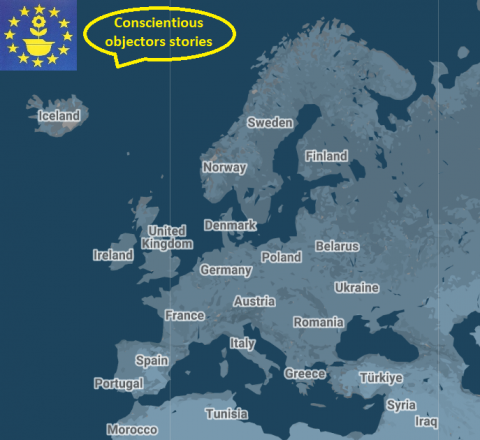
Conscientious objectors stories (videos)
#ObjectWarCampaign

EBCO Newsletter "The Right to Refuse to Kill"



Belgium

Previous reports: 2023/24
| Conscription currently imposed? | No |
Suspended 1993. Last conscripts demobilised 1995. Could be reinstated, but only in time of war. |
||||||
| Conscientious objection first recognised | 1964 | Law of 3rd June on Status of Conscientious Objectors | ||||||
| CO release of professional soldiers | – | No specific provision. Early release can be sought but may be denied for operational reasons. | ||||||
| Minimum recruitment age | 18 (nominally) | The formal requirement is to have completed mandatory education thus in fact a small number of 17 year olds are recruited each year. | ||||||
| Population 1 |
|
|||||||
| Armed forces |
|
|||||||
| Military expenditure |
|
|||||||
Principal EBCO concerns
- No recognition of the right to conscientious objection for professional soldiers or reservists.
Based on replies by the Belgian Ministry of Defence to the EBCO Questionnaire, and public information:
Developments
As detailed below, questions about asylum for conscientious objectors from Russia and Ukraine were discussed in the Federal Parliament.
Conscription provisions and procedures
Conscription is suspended since 1993.2 There are no specific provisions regarding the circumstances in which conscription could be reinstated. An amendment to article 1bis of the “Lois sur la milice, coordonnée le 30 avril 1962” (law concerning the conscription) would be necessary.
There is no ongoing registration procedure for those liable for military service.
Conscientious objection provisions and procedures
The provisions on conscientious objection are also suspended and, in case of reinstatement of conscription, would need to be amended separately to be effective.3
Voluntary recruitment
Belgium maintains voluntary armed forces, regulated by “Loi du 28 février 2007 fixant le statut des militaires et candidats militaires du cadre actif des forces armées”.
The formal requirement for recruits is to have completed mandatory education, thus in fact a small number of 17 year olds are recruited each year.
According to the Ministry of Defence, “there are […] protective measures to meet the requirements of international humanitarian law regarding child soldier rules” since:
-
“minors must provide the proof of the consent of the person or persons who exercises parental authority over them”;4
-
“for the candidate aged under eighteen the status of ‘military candidate' is automatically withdrawn when a period of war is decreed”;5
-
“in times of peace, soldiers who have not reached the age of eighteen may only wear weapons and military uniform when it's required for their training”;6
Total first-time military recruitment in the years 2022 to 2024 is shown in the table below.
| 2022 | 2023 | 2024 | ||||
|---|---|---|---|---|---|---|
| Age | F | M | F | M | F | M |
| 16 | 0 | 1 | 0 | 3 | 0 | 1 |
| 17 | 7 | 73 | 12 | 104 | 20 | 127 |
| 18 | 46 | 319 | 53 | 439 | 52 | 380 |
| 19 | 49 | 336 | 42 | 397 | 38 | 377 |
| 20 | 35 | 267 | 31 | 278 | 29 | 257 |
| 21 | 18 | 240 | 29 | 215 | 23 | 174 |
| 22 | 28 | 180 | 24 | 179 | 18 | 157 |
| 23 | 31 | 148 | 33 | 146 | 39 | 155 |
| 24 | 29 | 134 | 19 | 122 | 32 | 130 |
| 25 | 25 | 102 | 31 | 117 | 27 | 138 |
| 26 | 24 | 68 | 22 | 77 | 29 | 94 |
| 27 | 11 | 83 | 16 | 59 | 21 | 85 |
| 28 | 11 | 39 | 9 | 39 | 11 | 53 |
| 29 | 6 | 52 | 20 | 33 | 18 | 64 |
| 30 | 7 | 27 | 8 | 24 | 12 | 28 |
| 31 | 3 | 11 | 8 | 15 | 14 | 26 |
| 32 | 4 | 11 | 6 | 12 | 10 | 20 |
| 33 | 2 | 4 | 1 | 4 | 4 | 7 |
| 36 | 0 | 0 | 0 | 1 | 0 | 0 |
According to the Ministry, “Personnel in the Belgian Armed Forces under the Limited Duration Service (BDL) status starts with an initial eight-year contract, with the option to extend this by an additional four years, allowing for up to twelve years of service under BDL. Depending on career objectives and performance, personnel may transition to a career status for indefinite service, enabling long-term commitments within the Defense. Additionally, certain roles may allow for direct recruitment into career positions.”
For reserve service, the duration initially required is 10 years.7
Conscientious objection during and after military service
No specific provision. Early release can be sought but may be denied for operational reasons.
According to the Ministry of Defence, “The Law of 1980, which governs conscientious objection in Belgium, also applied to reservists. Because the laws are currently suspended, they are not applicable to reservists now,”8 but “to our knowledge, there have been no recent cases of individuals refusing reserve service on the grounds of conscientious objection.”
Asylum for conscientious objectors
The Agency in charge of refugees (CGRA/CGVS) does not have statistics specific on conscientious objectors.
In answer to a question in the Federal Parliament (Chamber) on 31 January 2024, Minister Nicole de Moor (Asylum and Migration) answered about Russian conscientious objectors:
‘In 2023, there were 931 requests for international protection of Russian nationals. These were mainly conscientious objectors, persons who fear mobilisation and political opponents.'
‘Processing of these files will in principle resume from February (2024). For each file, an individual assessment will take place, examining the motives for denial of service. It is impossible to say in advance how these applications will be treated. After all, it falls to the CGRS to do so independently.
With regard to humanitarian visas for conscientious objectors, I can inform you that this is one of the elements that can be taken into account. One must have a special fear. Refusal of service can be taken into account in the assessment of the visa application, but I am not aware of any concrete cases in this regard for the time being.'
On another parliamentary question on 28 February 2024, Minister Nicole de Moor (Asylum and Migration) stated:
‘(…), if conscientious objection - whether total or partial, for example in relation to the conflict in Ukraine - is invoked in the context of an application for international protection, it may give rise to the granting of international protection status, provided that this conscientious objection is sincere and, where appropriate, deeply rooted.
This aspect is examined on a case-by-case basis for each application for international protection. The fear invoked by the applicant must, of course, be well-founded. In other words, there must be a reasonable likelihood that the applicant will actually have to perform military service or be deployed in the conflict in Ukraine or in any other conflict. In addition, opponents of the war in Ukraine may also qualify for international protection because of their anti-war stance if the applicant has a well-founded fear of persecution upon return to their country of origin. This issue is also examined on a case-by-case basis for each application for international protection.'
Militarisation of the education system
According to the Ministry of Defence, “No programmes which could be seen as preparatory to military recruitment form an obligatory part of the secondary education curriculum”.9
However, the Armed Forces are “engaged in several programs designed to introduce young people to military careers” like a youth holiday camp “held during school vacations,” as well as “the cadet program, which runs activities on weekends and during school holidays.”
Moreover, “within the 3rd Degree in Defence and Security program, military personnel from the reserve corps are present in participating schools to conduct classes” where they provide “specialised instruction related to security and defence.”
-
Population and armed forces figures are derived from The Military Balance 2025, published by the international Institute for Strategic Studies; military expenditure figures are estimates published by SIPRI (The Stockholm International Peace Research Institute) in April 2025. ⤴
-
Loi du 31 décembre 1992 modifiant les lois sur la milice, coordonnée le 30 avril 1962.⤴
-
Lois portant le statut des objecteurs de conscience, coordonnées le 20 février 1980, as amended by Loi du 31 décembre 1992.⤴
-
Article 21, para. 6 of Loi du 28 février 2007 fixant le statut des militaires et candidats militaires du cadre actif des forces armées.⤴
-
Ibid. Article 21/1⤴
-
Ibid. Article 192⤴
-
Loi du 16 mai 2001 portant statut des militaires du cadre de réserve des Forces armées.⤴
-
Lois portant le statut des objecteurs de conscience, coordonnées le 20 février 1980, as amended by Loi du 31 décembre 1992.⤴
| Attachment | Size |
|---|---|
 BE_Ministry_of_Defense_Belgium_20241202.docx BE_Ministry_of_Defense_Belgium_20241202.docx | 293.41 KB |